
The Bottom Line: For general HVAC or clean environments, Shaft Grounding Rings (like AEGIS®) are a cost-effective way to divert shaft voltage. However, for harsh industrial environments involving conductive dust, moisture, or cutting fluids (CNC/Machining), Insulated Bearings are the superior choice. They physically block current and, unlike rings, are immune to the contamination that causes grounding brushes to fail.
If you are running Variable Frequency Drives (VFDs), you are likely fighting a silent killer: Electrical Discharge Machining (EDM).
You know the sound—that high-pitched screeching noise that signals your motor bearings are fluting. You replace the bearings, only to have them fail again in six months. It’s frustrating, expensive, and completely preventable.
To stop this, you generally have two weapons of choice: Shaft Grounding Rings (diverting the current) or Insulated Bearings (blocking the current).
But which one actually works when the conditions get tough? In this guide, we are going to look past the marketing brochures and into the reality of the workshop floor.
Here is what we will cover:
- Why “diverting” current is riskier than “blocking” it in dirty environments.
- The specific failure mode of grounding rings that manufacturers rarely talk about.
- Why CNC and machine tool applications require a completely different approach.
- A cost-benefit analysis: Is the higher upfront cost of insulated bearings worth it?
The Core Difference: Diverting vs. Blocking
Before we discuss reliability, we must understand the fundamental difference in physics. While both solutions aim to save your motor from VFD-induced shaft voltages, their methods are diametrically opposite.
Think of the stray current from your VFD as water trying to escape a dam.
- Shaft Grounding Rings act like a drain pipe. They accept that the water (current) is there, but they try to give it a safe, easy path to flow out (to the ground) so it doesn’t burst through the dam wall (your bearings).
- Insulated Bearings act like a thicker, taller dam wall. They simply refuse to let the water pass through. They block the path entirely, forcing the potential to stay harmlessly on the rotor or find a different path that doesn’t damage the rolling elements.


How Shaft Grounding Rings Work (The “Lightning Rod” Approach)
A shaft grounding ring (SGR) consists of a conductive ring with millions of microscopic conductive fibers—usually carbon fiber. These fibers gently ride on the rotating motor shaft.
The goal is to create a low-impedance path from the shaft to the motor frame (ground). In theory, the voltage will choose this easy path (“path of least resistance”) instead of struggling through the bearing grease and balls.
- Pros: Generally cheaper upfront; can be retrofitted to existing motors without disassembly.
- The Catch: It relies 100% on consistent physical contact. If that contact is broken—even microscopically—the protection fails instantly.
How Insulated Bearings Work (The “Fortress” Approach)
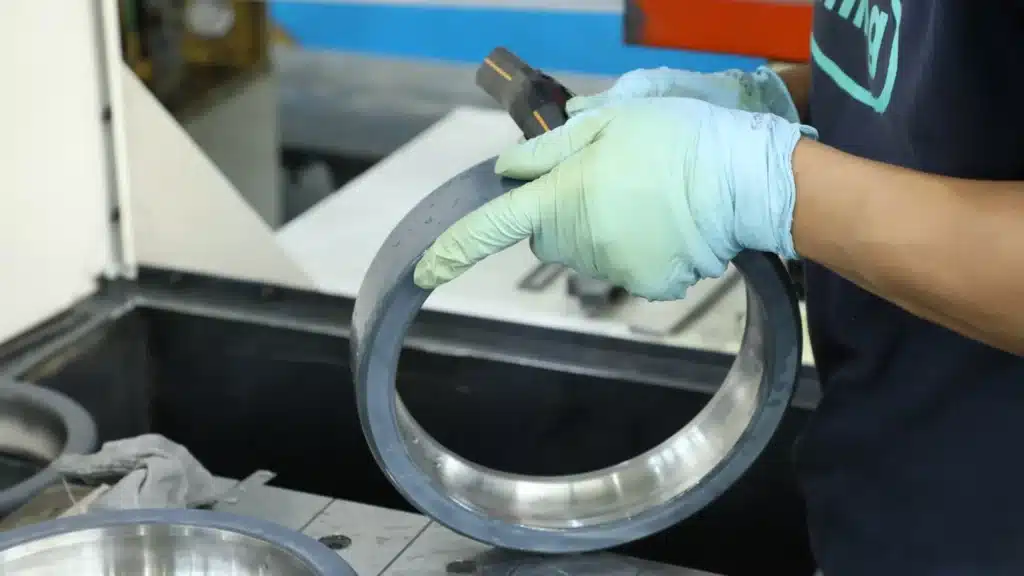
Insulated bearings (often called current-insulated bearings) solve the problem internally. Manufacturers like SKF, FAG, and NKE apply a thin layer of ceramic material (usually Aluminum Oxide, Al2O3) to either the outer ring or the inner ring using plasma spray technology.
This coating acts as a permanent dielectric barrier. It doesn’t divert the current; it stops the circuit from ever completing through the bearing.
💡 Expert Insight from Jessica:
Not all insulation is created equal. When sourcing insulated bearings for VFD applications, always check the Breakdown Voltage. Standard insulation should withstand at least 500V DC, but for heavy-duty industrial inverters (especially 690V systems), I always recommend specifying 1000V DC protection. This gives you a safety margin against voltage spikes that thin coatings can’t handle.
The “Dirty” Truth About Grounding Rings
If you read the brochures for grounding rings, they sound like the perfect solution. And in a clean room or a data center HVAC system, they often are. But in the real world of industrial manufacturing—especially in machine tools—they have a fatal flaw.
1. The “Micro-Gap” Problem
Friction is the enemy. Over time, the carbon brushes wear down. While they are designed to last, even a microscopic gap between the fibers and the shaft creates a problem.
Once a gap forms, the voltage has to “jump” across it. This arcing can damage the shaft surface itself, creating a rough patch that further accelerates brush wear. It’s a vicious cycle.
2. Contamination Kills Conductivity
This is the single biggest reason grounding rings fail in factories. For a grounding ring to work, it needs a clean metal surface. But what happens inside a factory?
- Oxidation: The copper or steel shaft oxidizes, creating a resistive layer.
- Grease & Oil: Vaporized grease from the bearings or nearby machinery settles on the shaft.
- Dust: Non-conductive dust gets trapped between the fibers and the shaft.
When this “sludge” builds up, it insulates the fibers from the shaft. The “low impedance path” is gone. The current looks for a new path, and guess where it goes? Right back through your bearings.
Why Machine Tool Environments Destroy Grounding Rings
This is the critical differentiator that most general guides miss. If your motor is driving a fan in a clean HVAC room, a grounding ring is fine. But if you are in a machine shop running CNC lathes, mills, or grinders, the environment is hostile.
The Impact of Cutting Fluids & Coolants
Machine tools are constantly bathed in cutting fluids and coolants. These fluids are designed to do two things: lubricate and cool. To do this, they form a persistent, high-strength film on every metal surface they touch—including the motor shaft.
When this fluid mist settles on the shaft where the grounding ring is riding, it creates an insulating barrier. The carbon brushes can no longer make electrical contact with the steel shaft. The grounding path is broken.
Suddenly, the voltage has nowhere to go. It builds up until it arcs through the bearing—exactly what you were trying to prevent.
Conductive Sludge: The Hidden Short
It gets worse. In a machining environment, the “dust” isn’t just dirt; it’s microscopic metal shavings. When these conductive metal particles mix with oil mist, they form a thick, conductive sludge.
- This sludge can pack into the grounding ring housing, causing the spring-loaded brushes to get stuck (they stop touching the shaft).
- It can bridge the gap between the ring and the motor face, creating unpredictable ground loops.
⚠️ From the Field (Jessica’s Note):
In CNC workshops, I’ve seen grounding rings fail in as little as 3 months. The owners thought the rings were defective, but they weren’t. They were just covered in a layer of dried coolant and metal fines. In these wet, oily environments, physical isolation (Insulated Bearings) is the only “fit and forget” solution.
The Insulated Bearing Advantage: Reliability Over Time
This is where insulated bearings (like SKF INSOCOAT or FAG Current-Insulated) shine. Because the protection is intrinsic to the bearing material, it doesn’t care about the environment.
- Zero Maintenance: There are no brushes to wear out, no springs to adjust, and no contact surfaces to clean.
- Consistent Specs: An insulated bearing has the same breakdown voltage on Day 1 as it does on Day 1,000.
- Life Cycle Cost (ROI): Yes, an insulated bearing costs 2-3x more than a standard bearing. But a grounding ring costs money too, plus the labor to install it. If a ring fails and you have to replace the motor bearings anyway, you’ve paid double.
Comparison: Grounding Ring vs. Insulated Bearing
| Feature | Shaft Grounding Ring | Insulated Bearing |
|---|---|---|
| Mechanism | Diverts Current (Path to Ground) | Blocks Current (Insulation) |
| Maintenance | High (Requires clean shaft contact) | Zero (Fit and Forget) |
| Environment | Clean, Dry (HVAC, Pumps) | Dirty, Oily, Wet (CNC, Mining) |
| Wear Parts | Carbon Brushes (Consumable) | None (Structural Ceramic) |
| Installation | Complex (Drilling/Epoxy required) | Simple (Direct Replacement) |

Installation Reality: Retrofit vs. Replacement
When you are in the middle of a breakdown, time is money. The complexity of installation is often the deciding factor.
Installing Grounding Rings (The “Hidden” Labor)
Many people choose grounding rings because they seem easier—”just bolt it on.” But proper installation is surprisingly delicate.
- Surface Prep is Critical: You must clean the motor shaft down to bare metal. Any paint, oxidation, or existing grease will ruin the conductivity.
- Centering: The ring must be perfectly centered. If it’s off by even a millimeter, the brushes will wear unevenly.
- Mounting: You often need to drill and tap the motor faceplate or use conductive epoxy. If you use epoxy, you have to wait for it to cure.
Installing Insulated Bearings (The “Drop-in” Solution)
In contrast, installing an insulated bearing is boring—in a good way.
Since insulated bearings adhere to standard ISO dimensions, they are a direct 1:1 replacement for your standard bearings. You don’t need to modify the shaft, drill holes, or mix epoxy. You simply pull the old bearing and press in the new one. The insulation is already part of the outer (or inner) ring.
The Hybrid Solution: When Do You Need Both?
Is there a scenario where you need both a belt and suspenders? Yes.
For large motors (typically above 100 HP / 75 kW) or medium-voltage applications, the physics changes. You aren’t just dealing with capacitive discharge; you are dealing with high-frequency circulating currents.
The “NDE Insulated + DE Grounded” Strategy
In these high-power scenarios, the industry standard best practice is a hybrid approach:
- Non-Drive End (NDE): Install an Insulated Bearing. This breaks the circuit, preventing current from circulating through the motor frame and back through the shaft.
- Drive End (DE): Install a Shaft Grounding Ring. This drains any residual shaft voltage to the ground, protecting the connected load (like the gearbox or pump bearings).
This combination offers the highest level of protection for critical, high-value assets where a failure would cost thousands in downtime.
💡 Expert Tip:
If you only insulate one side, make sure it is the Non-Drive End (NDE). This is usually easier to access for maintenance and forces the potential to stay away from the more complex Drive End coupling.
Frequently Asked Questions
Do ceramic (insulated) bearings need a grounding ring?
In most cases, no. If you install hybrid ceramic bearings (ceramic balls) or fully insulated bearings (coated rings) on both ends of the motor, you have effectively blocked the current path. Adding a grounding ring would be redundant for the motor bearings themselves. However, if you need to protect the driven equipment (like a gearbox) from coupled voltage, a grounding ring on the drive end might still be necessary.
How long do shaft grounding rings last?
Manufacturers claim they last the life of the motor (L10 life), but in reality, this depends heavily on the environment. in clean rooms, they can last 5-10 years. In dirty, oily, or humid environments (like CNC shops or paper mills), we often see them fail in under 6 months due to contamination preventing conductivity.
Can I retrofit an insulated bearing on an old motor?
Yes, absolutely. This is one of their biggest advantages. Insulated bearings are manufactured to standard ISO dimensions. You can remove a standard 6200 or 6300 series bearing and replace it directly with an insulated version (e.g., 6310-M-J20AA-C3) without any machining or modifications to the shaft.
Why are insulated bearings so much more expensive?
The cost comes from the plasma-sprayed ceramic coating (aluminum oxide) and the rigorous quality control required to ensure a consistent breakdown voltage (usually 1000V DC). While the upfront cost is 3-4x higher than a standard bearing, the Total Cost of Ownership (TCO) is lower because you avoid the downtime and labor cost of replacing fluted bearings every year.
Stop Replacing Bearings. Start Preventing Failure.
Don’t let a $50 grounding ring failure destroy a $5,000 motor. Upgrade to the “Fit and Forget” solution that handles the toughest CNC environments.
View Insulated Bearing Catalog →Compatible with SKF, FAG, and NSK standards.