
The Engineering Reality: Variable Frequency Drives (VFDs) control motor speed using Pulse Width Modulation (PWM). While efficient, this technique generates high-frequency Common Mode Voltage (CMV). Due to the parasitic capacitance of the motor, this voltage couples to the rotor shaft. When the accumulated voltage exceeds the dielectric strength of the bearing’s grease film, it arcs through the rolling elements, causing Electrical Discharge Machining (EDM) and premature failure.
You upgraded your facility to Premium Efficiency motors and added VFDs to every pump and fan. The energy savings calculation looked perfect on paper.
But six months later, you hear it: that distinct, high-pitched “screaming” noise from the motor bearings.
You pull the bearing and find the raceways are frosted and fluted. You replace it. Three months later, it happens again. Welcome to the paradox of modern motor control. The very device that saves you energy (the VFD) is actively destroying your mechanical components.
In this technical guide, we will break down:
- The physics of Parasitic Capacitance inside the motor gap.
- Why the Switching Frequency (Carrier Frequency) is a double-edged sword.
- The Voltage Reflection phenomenon in long cable runs (Standing Waves).
- IEEE-backed strategies to stop EDM currents permanently.
The Paradox: How VFDs Improve Efficiency but Destroy Bearings
To understand why bearings fail, we must first look at the output of the drive. Many engineers visualize the output of a VFD as a smooth sine wave with varying frequency. This is false.
The PWM Illusion (Pulse Width Modulation)
A VFD rectifies AC power to DC, and then uses Insulated Gate Bipolar Transistors (IGBTs) to chop that DC voltage into thousands of pulses per second. By varying the width of these pulses, it simulates a sine wave current.
However, the voltage waveform is a series of square waves with extremely fast rise times (high dv/dt). Unlike a true sine wave, the three phases do not sum to zero at any given instant. This imbalance creates a nonzero potential at the neutral point, known as Common Mode Voltage.
Parasitic Capacitance (The Ghost Capacitor)
In a standard 60Hz line-fed motor, the voltage is balanced, and the frame is grounded. The rotor is essentially at zero potential.
However, when fed by high-frequency PWM pulses, the motor stops acting like a simple inductive load. At these frequencies (kHz to MHz range), the air gap between the stator and rotor acts as a capacitor ($C_{sr}$).
The high dv/dt (rate of voltage rise) allows current to “jump” across this capacitive gap. This charges the rotor shaft like a battery. The shaft is now floating at a voltage potential relative to the grounded frame. The only thing separating this charged shaft from the ground is the thin film of grease inside your bearings.
The Physics of Failure: Common Mode Voltage & EDM
This is where the damage mechanism begins. It is a three-step process that repeats thousands of times per second.
1. Common Mode Voltage (CMV) Accumulation
In a balanced three-phase system, the vector sum of voltages is zero. But with PWM, the drive switches the DC bus voltage on and off rapidly. This creates a non-zero Common Mode Voltage at the motor’s neutral point. This voltage looks for a path to ground.
2. Dielectric Breakdown
The grease in your bearings is non-conductive (a dielectric). It acts as an insulator—up to a point. As the rotor shaft voltage builds up, it eventually exceeds the dielectric strength of the grease film (typically 10-40 Volts).
3. The “EDM” Effect (Electrical Discharge Machining)
ZAP. The voltage arcs through the grease film to the outer race (ground). This instantaneous discharge creates intense localized heat—hot enough to melt a microscopic pit in the steel ball and the raceway.
This is literally Electrical Discharge Machining (EDM) happening inside your motor. Over time, millions of these micro-pits align to form a rhythmic pattern known as fluting.
💡 Engineer’s Note (Jessica):
You can often hear fluting before you see it. It doesn’t sound like a normal grinding bearing. It produces a distinct high-pitched whine or howl that changes pitch with motor speed. If you open the bearing, look for the “washboard” pattern on the outer race—it looks like grey, frosted bands across the running track.

The Role of Switching Frequency & Rise Time
There is a common misconception that turning up the carrier frequency makes the motor run “smoother.” While it does reduce audible noise and current ripple, it increases the stress on your bearings and insulation.
The IGBT Switching Speed (dv/dt)
Modern VFDs use IGBTs (Insulated Gate Bipolar Transistors) that switch on and off at incredible speeds—often in less than 0.1 microseconds. This results in a massive dv/dt (Change in Voltage over Time).
High dv/dt allows current to penetrate the stray capacitance of the motor windings and the bearing grease film more easily. Essentially, the faster the switch, the more “leakage” current you generate across the air gap.
⚠️ Critical Tuning Tip:
Many technicians set the carrier frequency to 12kHz or 16kHz to stop the motor from “whining.” This is a mistake for reliability. Higher frequency means more pulses per second. If you have 16,000 pulses per second, you have 16,000 opportunities every second for a discharge to occur. Lower the carrier frequency to the minimum acceptable level (usually 2-4kHz) to extend bearing life.
Cable Length & Voltage Reflection (Standing Waves)
This is the phenomenon that kills motors even faster than bearing currents: Reflective Wave Voltage (also known as the Standing Wave phenomenon).
According to transmission line theory (and documented extensively in IEEE 141-1993), when there is an impedance mismatch between the VFD cable and the motor, the voltage pulse doesn’t just be absorbed by the motor. Part of it reflects back toward the drive.
If the cable is long enough (typically over 50 feet / 15 meters), the reflected wave collides with the incoming wave. These voltages add up (constructive interference).
- The Result: The voltage at the motor terminals can double.
- The Math: On a 480V system, the DC bus is ~680V. With voltage doubling, your motor insulation and bearings are getting hit with spikes of 1,200V to 1,600V.
- The Failure: Standard motor insulation is rated for 1,000V. These spikes punch through the first turn of the winding (Corona Inception Voltage) and accelerate bearing EDM.
Cables Matter: Why Standard Wire is Not Enough
If you are connecting your VFD to the motor with standard THHN/PVC building wire in a conduit, you are creating a radio transmitter, not a power circuit.
Impedance Mismatch
Standard wire has an undefined impedance that varies with how it lays in the conduit. VFD cable, however, is engineered with a specific impedance (surge impedance) to match the motor and drive. This significantly dampens the voltage reflection phenomenon we discussed above.
The Geometry of VFD Cables
To mitigate bearing currents, you need a low-impedance path for high-frequency noise to return to the drive—not through the motor bearings.
Proper VFD Cable (like Belden or Lapp) features:
- Symmetrical Grounds: Instead of one ground wire, it uses three smaller ground wires spaced symmetrically between the phases. This balances the electric field and cancels out induced noise.
- Overall Shielding: A copper braid or foil shield contains the electromagnetic interference (EMI) and provides a massive surface area for high-frequency noise to return to the source.
Protection Classes: Matching Strategy to Power & Voltage
Not every motor needs a $500 solution. The IEEE 141 and NEMA MG1 Part 31 standards suggest different levels of protection based on motor size and criticality.
Low Voltage / Small Motors (< 10 HP)
For smaller motors (under 10 HP / 7.5 kW) operating on 230V or 460V, the parasitic capacitance is low. The risk of EDM is present but manageable.
- Strategy: A single Shaft Grounding Ring (SGR) on the drive end is usually sufficient.
- Caveat: As discussed in our comparison guide, SGRs require maintenance and can fail in dirty environments.
Critical & Medium Voltage Motors (> 10 HP)
Once you exceed 10 HP, or if you are running on 575V/690V systems, the energy stored in the capacitive field increases exponentially. The “arc” is no longer a spark; it is a weld.
- The Risk: Circulating currents can now flow from the stator, through the rotor, and back through the opposite bearing.
- The Solution: You must physically break the circuit. Grounding rings alone are often overwhelmed by the high-frequency current magnitude.
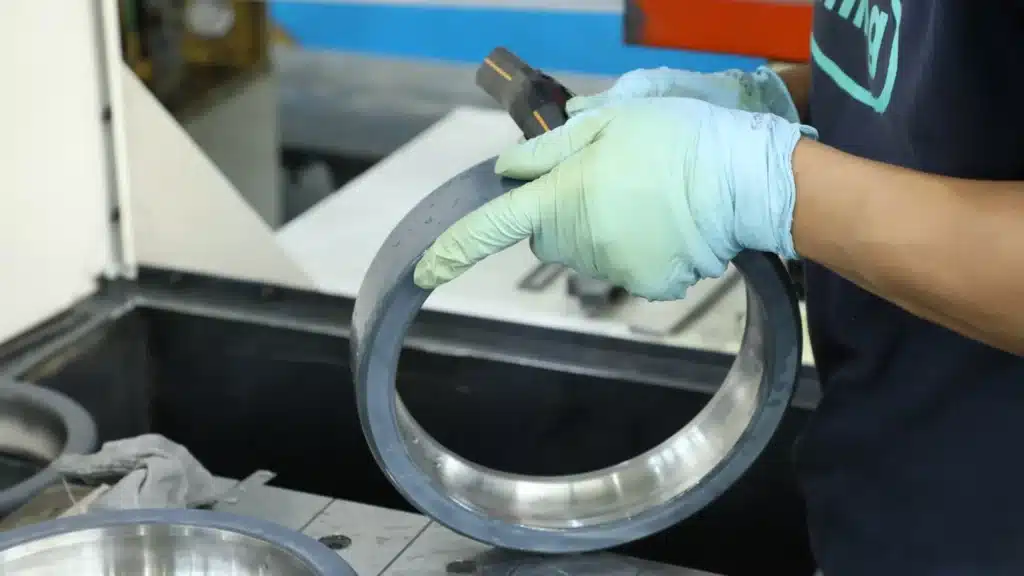
For these critical assets, the industry standard for reliability is to install inverter duty insulated bearings on the Non-Drive End (NDE). By coating the outer or inner ring with a plasma-sprayed ceramic, you increase the impedance to virtually infinity, blocking the EDM path entirely.
💡 Pro Tip (Jessica):
For motors above 100 HP (75 kW), don’t guess. Use the Hybrid Method: Install an insulated bearing on the NDE to block circulating currents, AND install a grounding brush on the DE to shunt shaft voltage. This protects both the motor and the driven load (gearbox/pump).

The System Prevention Checklist: Beyond Just the Bearing
Replacing a fluted bearing without fixing the root cause is just buying time until the next failure. To truly solve the VFD problem, you must address the entire system.
High-Frequency Bonding (The Skin Effect)
Standard green ground wires are designed for 60Hz safety, not megahertz noise. At high frequencies, current travels only on the surface of the conductor (the “Skin Effect”). A round wire has very little surface area relative to its cross-section.
The Fix: Use flat braided ground straps. These straps have a massive surface area, providing a low-impedance path for high-frequency noise to return to the drive chassis, bypassing the motor bearings.
Output Reactors & dV/dt Filters
If you cannot shorten your motor cables (e.g., in a deep well pump or a large conveyor system), you must mitigate the voltage reflection.
- Load Reactor (3-5% Impedance): Installed at the VFD output. It slows down the rise time (dv/dt) of the PWM pulses, reducing the stress on the motor insulation.
- dV/dt Filter: A more aggressive filter that clamps voltage spikes to a safe level (typically < 1,000V).
- Sine Wave Filter: The ultimate solution. It converts the PWM square wave back into a near-perfect sine wave. It eliminates bearing currents entirely but is expensive and bulky.
Conclusion: Don’t Let Efficiency Become a Liability
VFDs are essential for modern energy efficiency, but they introduce electrical stresses that mechanical components were never designed to handle. The physics of parasitic capacitance and voltage reflection are undeniable.
By upgrading to inverter duty insulated bearings and following IEEE guidelines for cabling and grounding, you can enjoy the energy savings of a VFD without the headache of monthly bearing changes.
Frequently Asked Questions
Does every VFD motor need insulated bearings?
Not necessarily. For small motors (< 10 HP) on standard voltage (230/460V), a shaft grounding ring is often sufficient. However, for motors above 10 HP (7.5 kW), or any motor in a critical application where downtime is costly, insulated bearings are highly recommended to physically block EDM currents.
How long can my VFD cable be before I need a filter?
As a rule of thumb, if your motor cable length exceeds 50 feet (15 meters), you should install an output reactor. If it exceeds 100 feet (30 meters), a dV/dt filter is critical to prevent voltage doubling (standing waves) that can destroy both bearings and windings.
What does bearing fluting sound like?
Fluting (EDM damage) creates a distinct noise often described as a high-pitched whine, howl, or screech. Unlike mechanical spalling which sounds like a low-frequency “growl” or “crunch,” fluting noise often changes pitch directly with the motor speed.
Can I just use a standard motor with a VFD?
Technically yes, but it is risky. Standard motors often use “General Purpose” insulation (Class F) which may not withstand the voltage spikes caused by PWM. A true “Inverter Duty” motor (NEMA MG1 Part 31) has upgraded winding insulation (1600V spike rated) and often comes with insulated bearings or grounding rings pre-installed.
Stop VFD-Induced Bearing Failure
Upgrading to Inverter Duty Insulated Bearings is the only maintenance-free way to block damaging shaft currents permanently.
View Inverter Duty Bearing Catalog →Available in Deep Groove Ball & Cylindrical Roller Series.