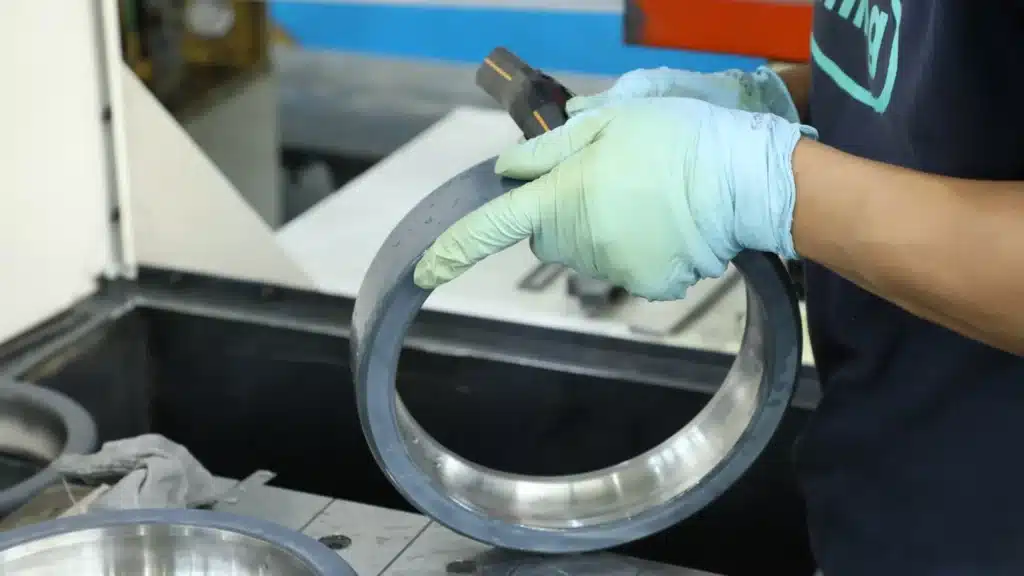

Electrically insulated bearings are specialized bearings featuring a non-conductive ceramic coating (usually Aluminum Oxide) on the inner or outer ring. This insulation acts as a barrier, blocking stray electrical currents from passing through the rolling elements, thereby preventing electrical erosion and extending motor life.
Are you tired of replacing motor bearings way ahead of schedule due to mysterious noise and vibration?
If you run modern electric motors—especially those controlled by Variable Frequency Drives (VFDs)—stray currents are likely destroying your bearings from the inside out. But there is a definitive solution.
In this guide, we will break down exactly how insulated bearings work to stop this damage cold. You’ll discover:
- The microscopic “lightning strikes” happening inside your motor.
- The critical difference between 500VDC and 3000VDC insulation.
- Why coating the outer ring is often the most cost-effective strategy.
What are Electrically Insulated Bearings? (Definition & Mechanics)
At first glance, an electrically insulated bearing looks identical to a standard bearing. The geometry, load ratings, and dimensions are standard (ISO compliant). The “magic” lies in a thin, yet incredibly robust layer of ceramic material applied to one of the bearing rings.
The Basic Concept: Breaking the Circuit
Think of your motor shaft, bearing, and housing as an electrical circuit. In standard motors, this circuit is open. But in VFD-controlled motors, high-frequency voltage can build up on the shaft. When this voltage exceeds the insulating capability of the lubricant film, it discharges.
Insulated bearings introduce a component with high electrical resistance (Impedance) into this path. By coating the outer ring (most common) or the inner ring, we effectively cut the wire, forcing the current to find a harmless path to ground (usually via a grounding brush), rather than arcing through your sensitive bearing raceways.

The Core Problem: Why Do We Need Insulated Bearings?
To understand the solution, we must first look at the destruction caused by stray currents. When electrical voltage passes through a bearing, it doesn’t just flow through smoothly; it arcs. This phenomenon is often called Electrical Erosion or EDM (Electric Discharge Machining) currents.
Understanding “Electrical Erosion” (The Silent Killer)
Inside a running bearing, the rolling elements ride on a microscopic film of oil or grease. This lubricant film acts as a natural insulator—but only up to a point.
When the shaft voltage (common in VFD motors) exceeds the dielectric strength of that oil film, the voltage “punches through.” This creates a tiny electric arc between the raceway and the ball or roller. The temperatures at the tip of this arc can exceed melting points of steel, causing the metal to melt and fuse instantly.
As the bearing continues to rotate, these fused points rip apart, leaving behind microscopic pits or craters. This is the beginning of the end.
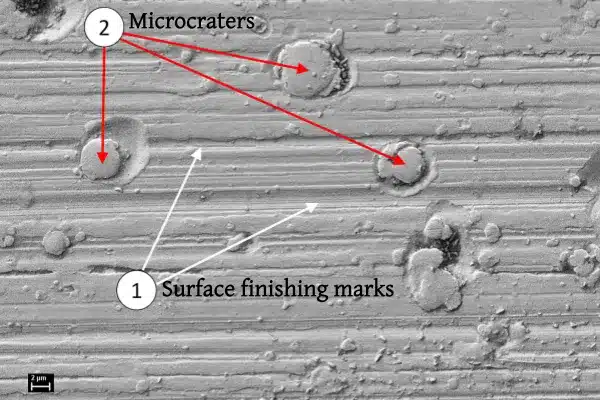
From Pitting to “Fluting” (The Washboard Pattern)
The damage shown in the image above is just the first stage. As these thousands of micro-craters accumulate, they change the geometry of the raceway. The rolling elements start to vibrate as they pass over the rough surface.
This vibration creates a self-perpetuating cycle, eventually forming a rhythmic pattern of parallel ridges known as Fluting or “Washboarding.” Once fluting appears, you will likely hear:
- A distinct, high-pitched whining noise.
- Increasingly loud vibration levels.
- Rapid degradation of the grease (often turning black due to burning).
The Role of VFDs (Variable Frequency Drives)
Why is this problem more common today? The answer lies in modern efficiency. Variable Frequency Drives (VFDs) are fantastic for controlling motor speed and saving energy. However, they use high-frequency switching (Pulse Width Modulation) to simulate AC power.
This high-frequency switching creates Common Mode Voltage, which searches for the path of least resistance to ground. Unfortunately, that path often leads straight through your motor bearings. Standard bearings act as the unwitting fuse in this circuit.
💡 Expert Insight: Detecting the Damage Early
In my experience analyzing failed motor bearings, many maintenance teams mistake electrical erosion for simple fatigue or lubrication failure. Here is a quick check:
If you open a failed bearing and see a “frosted” gray appearance on the raceway (instead of a shiny mirror finish) or distinct parallel lines (fluting), do not just replace it with another standard bearing. You have a current leakage problem. Only an insulated bearing or a grounding brush will solve the root cause.
Inside the Tech: Plasma Spraying & Material Composition
So, how do we stop electricity that can melt steel? The industry standard is Plasma Spraying.
The Magic of Aluminum Oxide (Al2O3)
The most effective insulation material used today is Aluminum Oxide ceramic. It offers a perfect balance of hardness, heat dissipation, and extreme electrical resistance.
- Process: The ceramic powder is injected into a plasma jet reaching temperatures up to 10,000°C.
- Bonding: The molten particles hit the bearing steel (usually the outer ring) and flatten, bonding mechanically to the pre-roughened surface.
- Sealing: Because plasma-sprayed coatings naturally have some porosity, a specialized resin sealant is applied to fill the gaps. This prevents moisture ingress, which could otherwise compromise the insulation properties in humid environments.
Decoding Insulation Ratings: 500VDC, 1000VDC, and 3000VDC
When selecting an insulated bearing, you aren’t just buying “protection”; you are buying a specific Breakdown Voltage capability. This rating defines the maximum voltage the ceramic layer can withstand before it fails and allows current to pass.
Most manufacturers (including SKF, FAG, and TFL) categorize these into three main tiers. Choosing the wrong one can be a costly mistake.
| Insulation Class | Breakdown Voltage | Best For… |
|---|---|---|
| Basic (VL0241) | Min. 500V DC | Older DC motors or environments with very low stray currents. (Becoming obsolete for modern VFDs). |
| Standard (VL0241 / J20A) | Min. 1000V DC | The Industry Standard. Perfect for 90% of industrial motors driven by VFDs (400V-690V grids). |
| High Performance (VL2071 / J20B) | Min. 3000V DC | Traction motors (Railways), Wind Turbines, and DC motors > 3000V. Requires thicker coating. |
💡 Bella’s Selection Tip: Go for the 1000V Standard
In the Chinese bearing market and global exports, we see a massive shift towards the 1000V DC (1kV) standard. Why?
Even if your current shaft voltage is only measuring 200-300V, transient spikes from VFD switching can easily jump higher. The price difference between 500V and 1000V insulation is often negligible, but the safety margin is doubled. Unless you are building a high-speed train (requiring 3000V), the 1000V spec is your safest bet for general industrial reliability.
Key Applications: Where are They Indispensable?
Insulated bearings are no longer a niche product; they are a necessity for any system prioritizing uptime. While they are critical in Electric Vehicles (EVs), their dominance is most visible in three heavy industries.
1. Industrial Electric Motors (VFD Driven)
This is the largest volume application. Pumps, compressors, and fans controlled by inverters are prime candidates for electrical erosion. Replacing standard deep groove ball bearings with insulated equivalents (like the 6200 or 6300 series) is a standard “drop-in” upgrade during maintenance.
2. Railway Traction Motors
Trains operate under extreme electrical loads. The traction motors that drive high-speed rail and metro systems face massive stray currents. Here, Railway Bearings often use Hybrid Ceramic options or heavy-duty 3000VDC coatings to ensure passengers never experience a breakdown in a tunnel.
3. Wind Power Generators
A wind turbine generator is located 100 meters in the air. Replacing a bearing up there requires a massive crane and costs a fortune. Therefore, wind turbine OEMs almost exclusively use insulated bearings for the generator to guarantee a 20-year service life.

Frequently Asked Questions
What is the difference between insulated bearings and hybrid ceramic bearings?
Great question. Insulated bearings use standard steel rings and balls, but coat one ring with a ceramic layer (Al2O3) to block current. They are cost-effective and handle high loads well. Hybrid ceramic bearings replace the steel balls with Silicon Nitride (Si3N4) ceramic balls. Hybrid bearings offer superior insulation and higher speed capabilities but are significantly more expensive.
Can I use insulated bearings in standard motors without VFDs?
Yes, absolutely. While standard motors (line-fed) have lower risk of shaft voltage, using insulated bearings adds a layer of protection against unforeseen grounding issues or future VFD retrofits. They are dimensionally interchangeable with standard bearings.
How long do insulated bearings last compared to standard ones?
In environments with stray currents (like VFD motors), standard bearings can fail in as little as 1-3 months due to fluting. An insulated bearing in the same environment restores the full L10 fatigue life of the bearing, potentially lasting 5-10 years depending on load and lubrication.
Do I need to ground the motor shaft if I use insulated bearings?
It depends on the motor size. For smaller motors (< 100kW), an insulated bearing on the non-drive end (NDE) is usually sufficient to break the circuit. For larger motors (> 100kW), it is best practice to use an insulated bearing on the NDE and a shaft grounding ring/brush on the drive end (DE) to fully protect the driven equipment.
Stop Electrical Erosion Before It Stops Your Business
Don’t let a $50 bearing ruin a $50,000 motor. TFL Insulated Bearings (VL0241 & VL2071) provide the ultimate shield against VFD currents.
View TFL Insulated Series »Available in 500VDC, 1000VDC, and 3000VDC specifications.