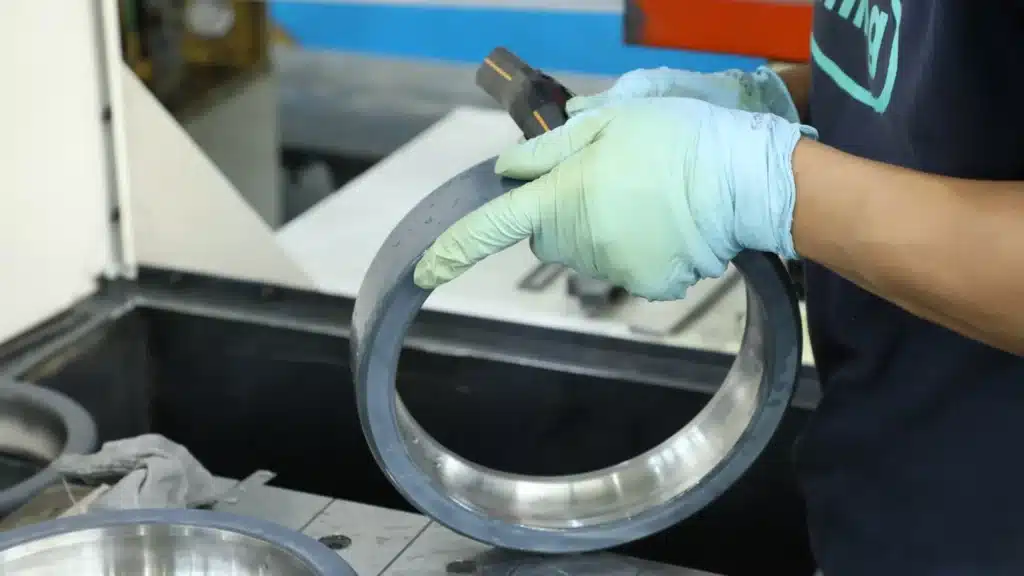

Stray electrical currents are one of the most destructive-and least understood-enemies of bearings in modern electric motors, generators, and EV drivetrains. They silently pass through rolling contacts, creating electrical pitting, fluting, noise, and premature failure. Ceramic-coated bearings offer a robust, drop-in solution: they integrate a durable ceramic insulation layer directly on the bearing ring, blocking shaft currents while preserving standard dimensions and load capacity.
This guide explains what stray currents are, how they damage bearings, how ceramic-coated bearings work, and why they are often the most cost-effective protection choice for VFD-driven and high-voltage applications.
Understanding Stray Currents and Bearing Damage
What Are Stray Currents?
In modern drive systems, high-frequency inverters, long motor cables, and electromagnetic asymmetries generate shaft voltages between rotor and stator. When there is no safe low-impedance path to ground, these voltages discharge through the bearings as current. The resulting electrical activity is often called:
- Bearing currents
- Stray currents
- Electrically induced bearing damage (EIBD)
Even currents of only a few amperes, repeated at high frequency, can cause severe wear over time.
How Stray Currents Destroy Bearings
When shaft voltage exceeds the breakdown strength of the lubricant film, tiny arcs jump between rolling elements and raceways. Each discharge melts a microscopic volume of steel and ejects it, leaving a crater. Over millions of events, this leads to:
- Electrical pitting: frosted surfaces and small craters.
- Fluting: washboard-like grooves along raceways.
- Lubricant carbonization: dark, burnt grease that loses its dielectric strength.
The bearing becomes noisy, vibrates, heats up, and eventually fails long before its mechanical L10 life is reached.

Traditional Ways to Deal With Stray Currents
Before ceramic-coated bearings were widely available, engineers tried a mix of partial solutions:
- Shaft grounding brushes or rings: provide a conductive path for current, but wear, contamination, or poor installation can reduce effectiveness.
- Insulating couplings: block current through the drive train, but add cost and complexity.
- Special cabling and filters: reduce common-mode voltages but cannot always eliminate shaft currents, especially in large or long-cable systems.
These methods can help, but they often require additional components and careful maintenance. Ceramic-coated bearings address the problem at the bearing itself.
How Ceramic-Coated Bearings Work
The Role of the Ceramic Layer
Ceramic-coated bearings are standard rolling bearings whose inner or outer ring is covered with a thin, high-resistance ceramic layer, commonly plasma-sprayed aluminum oxide (alumina).
This layer:
- Electrically insulates the ring from the shaft or housing.
- Provides megaohm-level resistance, even in humid or harsh environments when properly sealed.
- Maintains the same external dimensions as standard bearings, making them easy drop-in replacements.
By interrupting the conductive path between shaft and frame, the coating forces stray currents to find another route to ground instead of crossing the rolling contacts.

Coating Location: Inner vs Outer Ring
Manufacturers offer several variants:
- Outer-ring coated bearings – insulation between bearing and housing.
- Inner-ring coated bearings – insulation between bearing and shaft.
The choice depends on where the main current path is and what is easiest to insulate in the system design. In many industrial motors an outer-ring coating is common because the frame is usually at ground potential.
Key Advantages of Ceramic-Coated Bearings Against Stray Currents
Integrated, Reliable Insulation
Because the ceramic layer is built directly onto the bearing ring, insulation performance does not depend on external parts like brushes or couplings. When properly manufactured, coatings provide:
- High insulation resistance (typically tens of megaohms or more).
- Dielectric strength sufficient to withstand common inverter-induced shaft voltages.
This integrated design reduces the risk of protection being bypassed by dirt, wear, or misadjusted contacts.
Drop-In Replacement with Standard Dimensions
Ceramic-coated bearings are designed to be dimensionally interchangeable with standard bearings, so you typically can:
- Install them in existing housings and on existing shafts.
- Use familiar fits, clearances, and mounting procedures.
This simplicity is a significant advantage over insulation systems that require redesign of couplings, shafts, or motor frames.
Robust Mechanical Strength
The steel core of the coated ring retains:
- Standard load ratings.
- Familiar fatigue behavior.
- Good toughness and shock resistance.
The ceramic layer is engineered to be thick enough for electrical insulation but thin and well-bonded enough to avoid cracking or spalling under load and vibration.
Resistance to Corrosion and Contamination
Ceramic layers also provide corrosion protection. In humid, chemically aggressive, or dirty environments, a coated ring is less likely to rust or suffer surface degradation than bare steel, contributing to longer service life.
Cost-Effective for Many Motors Sizes
Compared with full-ceramic or high-end hybrid bearings, ceramic-coated steel bearings often offer:
- Lower purchase cost.
- Easier availability in a wide range of ISO sizes.
- Good balance between electrical protection and mechanical robustness.
For many motors and generators, especially in industrial plants, they represent the best value per unit of reliability gained.
Ceramic-Coated Bearings vs Other Insulation Technologies
Coated Bearings vs Hybrid Ceramic Bearings
Hybrid bearings use steel rings with ceramic balls. The balls themselves are non-conductive, offering complete isolation of the rolling contact. However:
- They can be more expensive than coated bearings.
- Ceramic balls change dynamic behavior and can be more sensitive to shock if not correctly applied.
Lab and field comparisons have shown that coated rings often withstand higher breakdown voltages and offer more stable performance in dirty industrial environments. At the same time, hybrids excel at ultra-high speeds and extreme temperatures.
Coated Bearings vs Full-Ceramic Bearings
Full-ceramic bearings (ceramic rings and balls) provide maximum insulation and corrosion resistance, but:
- They are costly and generally reserved for specialized applications (vacuum, extreme temperature, non-magnetic environments).
- They have different thermal expansion and toughness characteristics compared with steel.
For most stray-current issues in standard motors, ceramic-coated steel bearings provide adequate insulation at much lower cost.
Table: Comparison of Bearing Solutions Against Stray Currents
| Feature | Standard Steel Bearings | Ceramic-Coated Bearings | Hybrid Ceramic Bearings |
| Stray current protection | None | High (ring insulated) | Very high (balls insulated) |
| Typical insulation resistance | ~0 Ω | MΩ range | MΩ range |
| EDM / fluting risk | Very high | Very low | Very low |
| Dimensional interchangeability | Baseline | Same as standard | Same as standard |
| Relative cost | Low | Medium | Higher |
| Best use cases | Non-VFD, low voltage | VFD motors, generators | High-speed, demanding drives |
Key Design Parameters: Thickness, Hardness & Dielectric Performance
Coating Thickness
Typical ceramic coating thickness on bearing rings is on the order of 50–200 micrometers (µm).
- Too thin: risk of pinholes, low breakdown voltage.
- Too thick: risk of cracking, dimensional changes, and reduced heat transfer.
Manufacturers optimize thickness so the coating provides sufficient insulation (often up to 1000 V or more DC) while preserving standard fits and mechanical behavior.
Hardness and Adhesion
Plasma-sprayed alumina coatings are significantly harder than steel, providing good wear and fretting resistance. However, hardness must be balanced with:
- Strong adhesion to the steel ring.
- Controlled porosity and residual stress to reduce crack risk.
High-quality bearing coatings undergo adhesion, impact, and thermal cycling tests to ensure they withstand years of vibration and temperature changes.
Dielectric Strength and Insulation Resistance
Manufacturers specify:
- Minimum insulation resistance (e.g., ≥50 MΩ at 500 V DC).
- Breakdown voltage of the coating system (often above 1000 V).
These ratings are chosen to comfortably exceed expected shaft voltages and common mode peaks from inverters in typical installations.
Where Ceramic-Coated Bearings Deliver the Most Value
VFD-Driven Industrial Motors
In variable-speed drives for pumps, fans, compressors, and conveyors, VFD output often creates damaging shaft currents. Ceramic-coated bearings:
- Prevent electrical erosion in both new and retrofitted motors.
- Reduce noise and vibration caused by fluted raceways.
- Extend maintenance intervals and cut unplanned stoppages.

Wind Turbine and Large Generators
High-power generators operate with strong electromagnetic fields and complex grounding systems, making them susceptible to bearing currents. Coated bearings in generator ends:
- Block circulating currents.
- Improve uptime in remote or hard-to-access installations like wind farms and hydro plants.
EV and Rail Traction Motors
Traction motors in EVs and trains are fed by high-frequency inverters and subject to wide speed ranges and frequent torque reversals. Ceramic-coated bearings:
- Protect against high dv/dt and variable voltage stress.
- Help meet strict NVH requirements by preventing bearing-induced whine.
- Resist corrosion from road salt and environmental moisture.
Practical Selection Tips for Engineers and Buyers
i. Define Electrical Requirements
- Estimate shaft voltage and current levels.
- Consider inverter type, cable length, and grounding scheme.
- Choose coated bearings whose insulation ratings exceed these conditions.
ii. Check Mechanical Compatibility
- Confirm load rating, speed rating, and internal clearance.
- Verify that the coated bearing has the exact ISO dimensions as the original.
iii. Consider Environment
- For high humidity or chemical exposure, select coatings and sealants proven to maintain resistance under those conditions.
iv. Plan Grounding Strategy
- In some systems, using one insulated bearing and one grounded bearing (with a grounding ring) gives optimal performance.
- Coordinate with motor and drive manufacturers for best practices.
v. Verify Quality and Test Data
- Look for documentation on insulation resistance, breakdown voltage, and coating process control.
- For critical applications, perform incoming insulation-resistance spot checks.
Best-Practice Checklist for Using Ceramic-Coated Bearings Against Stray Currents
- Identify motors where VFDs, long cables, or high power make stray currents likely.
- Specify ceramic-coated bearings for at least one end of the motor (often the non-drive end).
- Ensure coating ratings meet your voltage and environmental requirements.
- Integrate shaft grounding, filters, or improved cabling where necessary for additional protection.
- Monitor bearing condition with vibration and temperature trends; electrical erosion should no longer appear.
Stray currents are a known, pervasive cause of premature bearing failure in today’s electrically sophisticated machinery. Ceramic-coated bearings directly address this issue by integrating a high-resistance barrier into the bearing itself, blocking current flow through the rolling contact zone while preserving the mechanical robustness and dimensions of standard steel bearings.
By combining optimized coating thickness, high hardness with strong adhesion, and proven dielectric strength, modern ceramic-coated bearings offer a reliable, cost-effective solution to stray currents in VFD-driven motors, generators, EV drives, and more. For many applications, they are indeed the best single line of defense-simpler than complex external grounding systems and more economical than full-ceramic alternatives-delivering longer bearing life, quieter operation, and higher overall system reliability.
Protect Your Equipment with TFL Insulated Bearings
At TFL Insulated Bearings, we understand that stray currents are silent killers of productivity. We know that every minute of downtime caused by bearing failure costs you money. That is why we have engineered our ceramic-coated bearings to provide the ultimate defense for your VFD-driven motors and generators, ensuring long-lasting performance even in the harshest electrical environments.
Don’t wait for your next motor failure to upgrade your protection.
- Looking for a specific model? Check our extensive inventory of insulated bearings.
- Need a custom solution? Our engineering team is ready to assist you.
Contact Us Today for a Quote or Technical Consultation:
- Email Us: info@sdtflbearing.com
- Call Us: +86 15806631151
- Inquiry Form: Click the “Contact us” button on the sidebar to send us your requirements immediately.
Get the reliability you deserve—Switch to TFL Insulated Bearings.