
Are you tired of diagnosing premature bearing failures only to find the tell-tale “fluting” marks of electrical erosion? With the widespread adoption of Variable Frequency Drives (VFDs), shaft voltages have become the silent killer of modern spindle motors.
You know you need protection, but the choice between Hybrid Ceramic and Insulated (Coated) Bearings isn’t just about price—it’s about matching the physics of the bearing to your machine’s specific demands.
In this guide, we will cut through the marketing noise and reveal:
- The molecular differences between Silicon Nitride and Alumina coatings.
- Why “expensive” ceramic bearings might actually be overkill for your application.
- The 50% Savings Rule: A calculation method to determine your best ROI.
- A definitive decision matrix for maintenance engineers.
Material Science: Silicon Nitride (Si3N4) vs. Alumina Coating
To make the right choice, you first need to understand what is happening inside the race. While both solutions aim to stop electrical current from arcing through the bearing elements, they achieve this through fundamentally different engineering approaches.

The Physics of Hybrid Ceramic: Why Silicon Nitride (Si3N4) is King
In a hybrid ceramic bearing, the standard steel balls are replaced with Silicon Nitride (Si3N4) spheres. This isn’t just a material swap; it’s a phase shift in performance. Silicon Nitride is a covalent bond material, meaning it doesn’t share electrons—making it a natural electrical insulator.
Beyond its dielectric properties, Si3N4 is 58% lighter than steel. Why does this matter? When a spindle accelerates to high speeds, the centrifugal force of the balls pushing against the outer race creates immense friction and heat. Because ceramic balls are lighter, they exert less force, allowing for cooler operation and extended grease life.
Think about it this way: At 20,000 RPM, steel balls are struggling against their own weight. Ceramic balls, however, are just getting started. They offer a lower coefficient of friction and a higher modulus of elasticity, meaning they don’t “squish” or deform under high-speed pressure.
How Alumina Coating Works: The “Shield” Approach
Insulated bearings, often referred to as “coated bearings,” take a different approach. They keep the traditional chrome steel balls but apply a thin layer (usually 100 to 300 microns) of Alumina (Al2O3) to the outer or inner ring using a sophisticated plasma-spraying technique.
This oxide layer acts as a barrier, preventing stray currents from passing from the motor housing through the bearing to the shaft. While the steel balls inside remain conductive, the current simply cannot find a path to ground through the coated race.
Speed Performance: Why High-Speed Spindles (>20,000 RPM) Demand Ceramics
If your application involves ceramic bearings for spindle assemblies, speed is likely your primary constraint. There is a “red line” in engineering where steel balls simply cannot compete with hybrids, regardless of how well they are lubricated.
- Reduced Centrifugal Loading: Because ceramic balls are 40% the density of steel, they reduce the internal loading on the raceway at high speeds.
- Lower Thermal Expansion: Si3N4 has a thermal expansion coefficient only 25% that of steel. As the bearing heats up, the internal clearance remains stable, preventing “thermal runaway” seizures.
- Vibration Dampening: The higher stiffness (Modulus of Elasticity) of ceramic balls pushes the resonant frequency of the spindle higher, leading to a smoother finish in CNC machining.
For high-speed motor spindles, the choice isn’t just about preventing EDM (Electrical Discharge Machining) damage; it’s about mechanical survival. Once you cross the 20,000 RPM threshold, the “parasitic” heat generated by steel balls becomes uncontrollable.
Insulation Integrity: Physical Barriers vs. Coating Resistance
While both technologies aim to stop electrical erosion (EDM), their “stopping power” is measured differently. If you are dealing with high-frequency VFD noise, the dielectric strength of your solution is the only metric that matters.
Dielectric Strength: Comparing Breakdown Voltage
Hybrid ceramic bearings offer an absolute physical barrier. Silicon nitride is a non-conductive material through and through. There is no “layer” to fail; the ball itself is the insulator. This makes them virtually immune to electrical breakdown, even in extreme shaft voltage scenarios.
Insulated bearings, conversely, rely on the integrity of the Alumina layer. Most standard high-performance insulated bearings are rated for a breakdown voltage of 1,000V to 3,000V DC. While this is more than enough for 95% of industrial motor applications, the coating can be compromised by deep scratches during installation or chemical degradation of the coating bond.
| Feature | Hybrid Ceramic Bearings | Insulated (Coated) Bearings |
|---|---|---|
| Insulation Method | Inherent (Material-based) | Surface Layer (Plasma Spray) |
| Dielectric Strength | Unlimited (Non-conductive) | Up to 3,000V DC |
| Service Life | Longest (High Wear Resistance) | Medium (Coating dependent) |
Cost-Benefit Analysis: The ROI of “Over-Engineering”
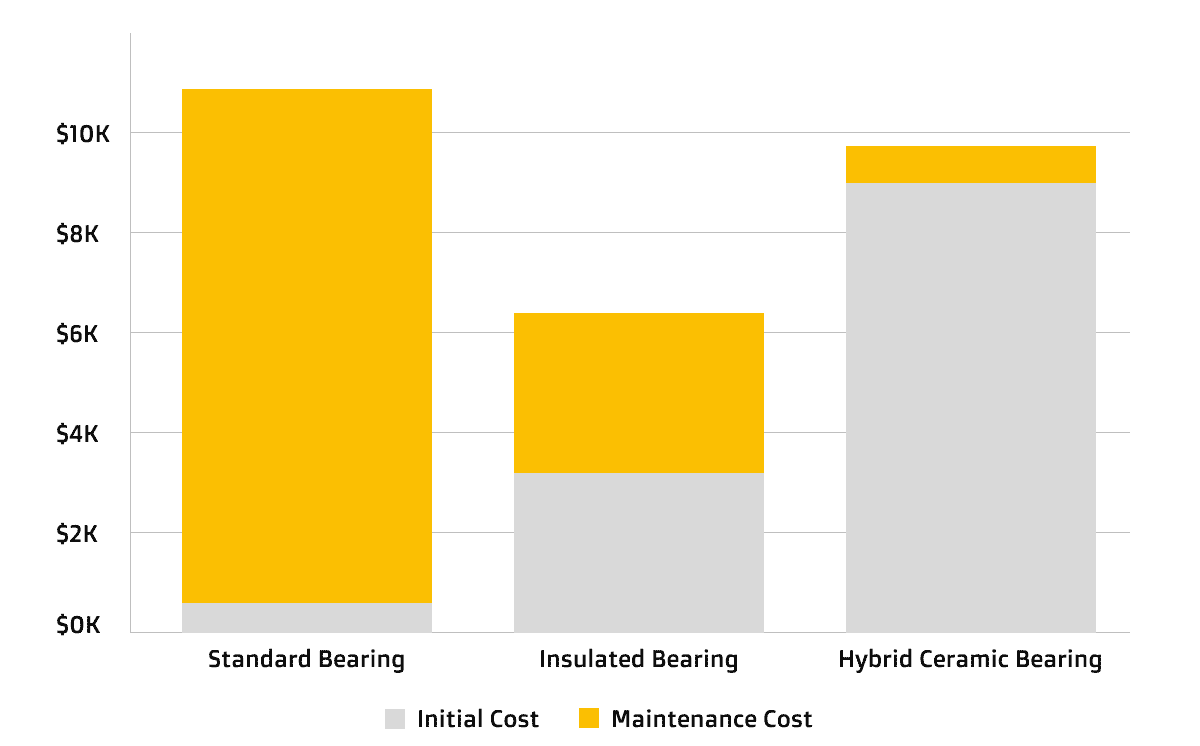
This is where most maintenance managers make a mistake. They assume “more expensive equals better.” However, specifying a hybrid ceramic bearing for a low-speed pump motor is often a waste of capital.
The 50% Savings Rule: When to Skip Ceramics
Based on our field data at the Scientific Advisory Board, we’ve developed a simple ROI rule. For motors running at speeds below 6,000 RPM with a focus solely on preventing electrical erosion, choosing precision insulated bearings can save you up to 50% in upfront procurement costs compared to hybrid ceramics.
The cost premium of silicon nitride balls is significant. In medium-speed applications, the mechanical benefits of ceramic (centrifugal force reduction) are negligible. In these cases, you are paying for speed performance you aren’t using. By switching to an insulated steel-ball bearing, you gain the same EDM protection while keeping your maintenance budget lean.
Rigidity & Load Capacity: When Steel Balls Win
There is a common misconception that ceramic is always “better.” However, in the world of heavy-duty machining and high-torque motors, the elasticity of steel can actually be an advantage. This is where insulated bearings (which retain steel balls) often outperform their hybrid counterparts.
Young’s Modulus & Elastic Deformation
Silicon Nitride (Si3N4) has a Young’s Modulus approximately 50% higher than steel. In layman’s terms, ceramic balls are much stiffer. While this is excellent for high-speed precision (less “spindle flutter”), it means the contact patch between the ball and the race is smaller.
For applications involving heavy-duty cutting or high shock loads, the slightly more “elastic” nature of steel balls in an insulated bearing allows for a larger contact area. This distributes the load more evenly, reducing the risk of sub-surface fatigue or “brinelling” (permanent indentation of the race) during a crash or high-impact operation.
Heavy-Duty Cutting: The Rigidity Paradox
If your spindle is used for heavy roughing of hardened steel at lower RPMs, the extreme stiffness of ceramic balls can actually transmit more vibration into the spindle housing. In these specific scenarios, the damping characteristics of steel balls—found in high-performance insulated bearings—provide a more stable machining environment and can even extend the life of your cutting tools.
Final Verdict: The Selection Decision Matrix
To simplify your procurement process, use the following checklist to determine which technology fits your specific machine profile. Choosing the wrong one isn’t just a waste of money—it’s a risk to your uptime.
- Choose Hybrid Ceramic Bearings IF:
- Your spindle speeds exceed 20,000 RPM.
- You require maximum precision and minimal thermal expansion.
- You are in a “maintenance-free” high-end CNC environment.
- Weight reduction of rotating parts is critical for acceleration.
- Choose Insulated (Coated) Bearings IF:
- You are running standard industrial motors (Pumps, Fans, Conveyors).
- Speeds are below 10,000 RPM but VFD-related EDM damage is present.
- You need to protect large-frame motors where ceramic balls would be cost-prohibitive.
- The application involves high shock loads or heavy vibration.
Frequently Asked Questions
Are hybrid ceramic bearings completely non-conductive?
Yes. The silicon nitride (Si3N4) balls used in hybrid bearings are natural insulators with extremely high dielectric strength. They do not allow electrical current to pass through the rolling elements, effectively breaking the circuit and preventing EDM damage.
How long does the coating on insulated bearings last?
Under normal operating conditions, the alumina coating is designed to last the entire service life of the bearing. However, improper handling during installation (such as using a hammer directly on the coated surface) or extreme chemical exposure can cause the coating to chip or degrade, compromising its insulation properties.
Can I replace a standard steel bearing with a hybrid ceramic one?
Technically, yes, as long as the dimensions (ISO standards) match. However, because hybrid ceramics have different thermal expansion rates and higher stiffness, you may need to adjust your housing tolerances and lubrication intervals to ensure optimal performance.
Which is better for VFD-driven motors?
Both are effective against VFD-induced stray currents. For high-speed precision spindles, hybrid ceramics are superior. For standard industrial motors where cost is a major factor, insulated bearings provide the most practical and economical protection.
Optimize Your Spindle Performance Today
Don’t let electrical erosion bring your production to a halt. Whether you need the extreme speed of hybrid ceramic bearings or the cost-effective protection of precision insulated bearings, our engineers are here to help you select the perfect fit.
Browse High-Performance Bearings