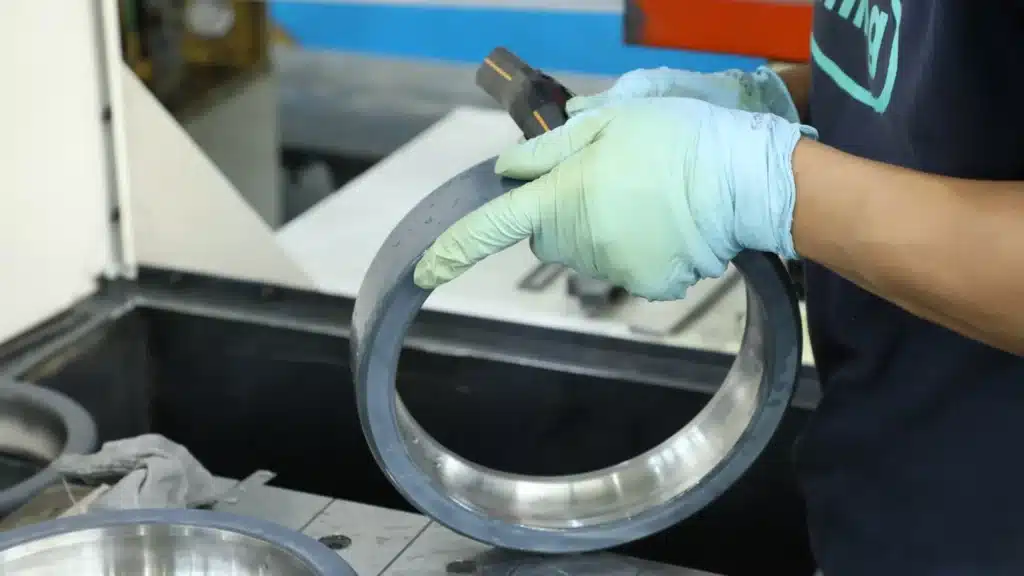

Electrically insulated bearings have become a critical component in modern industrial drive and control systems, profoundly impacting long-term equipment stability, maintenance requirements, and total lifecycle economics. With the widespread adoption of Variable Frequency Drives (VFDs), high-speed machinery, and smart manufacturing, bearing failure caused by electrical erosion has become a primary concern for maintenance and procurement teams. TFL is dedicated to providing high-performance, customized insulated bearing solutions for global markets—including rail transit, wind power, machinery manufacturing, mining, and petrochemicals—through factory-direct supply and proprietary patented processes.
TFL insulated bearings combine advanced plasma-sprayed alumina ceramic coatings, high-purity steel substrates, and optimized cage structures to overcome many technical bottlenecks of traditional electrical protection. Through a rigorous quality system and global standard certifications, TFL not only reduces the total cost of ownership (TCO) but also significantly enhances equipment availability and operational efficiency. This article systematically outlines the causes of electrical erosion, TFL’s core technical advantages, quality assurance details, and real-world application benefits to help procurement managers and engineers maximize their return on investment.
When making decisions regarding equipment upgrades or maintenance using insulated bearings, it is recommended to combine actual working conditions with professional advice to ensure compliance with industry-specific certifications. The content provided herein serves as a technical and selection reference. For precise parameters or specialized environment selection, please consult the TFL technical engineering team.
Introduction: The Importance of Insulated Bearings
Electrical Erosion Challenges and Solutions
- Definition of Electrical Erosion: In motors or generators using VFDs, high-power converters, or unbalanced loads, high-frequency shaft voltages are formed. These micro-currents break down the lubricant film at the bearing contact points, causing localized burns, pitting, and “fluting” damage—a phenomenon known as electrical discharge machining (EDM) or electrical erosion.
- Damage Mechanism: The current flow generates instantaneous high temperatures, leading to localized annealing, micro-welding, or material spalling on the raceways and rollers. This increases surface roughness and noise, degrades lubrication, and accelerates fatigue failure.
- Economic Impact: Premature bearing failure leads to sudden equipment downtime and increased repair costs, negatively impacting production schedules and directly driving up lifecycle management expenses.
Impact on Equipment Life and Operating Budgets
- Without insulated protection, the fault-free life of VFD motor bearings is often reduced to 30% or less of its design life.
- Taking machine tool spindle bearings as an example, a single failure (replacement + calibration) can result in up to $4,500 per year in downtime and labor losses.
- Symptoms such as increased bearing noise, overheating, and lubricant discoloration are typically closely related to electrical erosion damage.
Typical Application Scenarios
- VFD Motors and High-Frequency Drive Equipment: Insulated bearings prevent high-frequency shaft current damage, improving motor system reliability and service cycles.
- Railway Traction Motors: Where safety and performance are paramount, insulation reduces sudden failure rates caused by EDM, ensuring continuous operation.
- Wind Turbine Main Shafts: Designed to resist electrical stress and environmental degradation in climate-exposed turbines, reducing the risk of expensive overhauls.
- Top Drives, Mining Conveyors, Petrochemical Pumps: Provides effective isolation in high-interference environments, extending maintenance intervals.
For more typical structures and applicable conditions, see the TFL Insulated Motor Bearings Detailed Introduction.
TFL Core Technology Analysis
Advantages of Plasma-Sprayed Ceramic Process
TFL utilizes a proprietary plasma spraying process to deposit alumina ceramic material at extremely high temperatures and velocities onto the bearing surfaces (usually the outer ring), followed by multi-layer resin sealing to form a dense, high-strength insulating barrier.
- High Density: Multiple spray layers ensure extremely low porosity, effectively blocking all current paths even under high-voltage VFD surges.
- Superior Adhesion: The bond strength between the ceramic and the high-purity steel substrate exceeds 30 MPa, ensuring no risk of cracking or peeling.
- Uniform Thickness: Combined with CNC precision grinding, coating thickness is controlled uniformly between 0.3 – 0.7 mm to meet specific speed and load requirements.
- Sealed Protection: The resin sealing barrier resists water and oil, strengthening durability in humid, dusty, or corrosive environments.
Key Performance Metrics and Core Indicators
| Indicator / Parameter | TFL Insulated Bearing Ceramic Coating |
|---|---|
| Dielectric Breakdown Voltage | ≥1000V DC (Up to 3000V DC for specific models) |
| Coating Thickness | 0.3 – 0.7mm (Customizable) |
| Microhardness (HV) | 700 – 1000 HV |
| Adhesion Strength | ≥30 MPa |
| Insulation Resistance | ≥100 MΩ |
| Moisture/Heat Resistance | Compliant with ISO/TR 8646 |
Alumina Ceramic Coating Performance Analysis
- Bonding and Spalling Resistance: Thanks to unique surface activation, the ceramic layer withstands millions of revolutions and thermal/humidity shocks without damage.
- Insulation Stability: The high-resistance coating and multi-layer sealing remain effective after long-term 1000V DC breakdown tests, meeting the extreme needs of traction motors and wind power.
- Physical Wear Resistance: High-hardness ceramics significantly improve the coating’s resistance to dust, impurities, and oil sludge erosion.
High-Purity Steel and Cage Optimization
- Material Selection: All load-bearing components use high-purity SUJ2 (international equivalent) bearing steel, subjected to advanced heat treatment and isothermal quenching for enhanced fatigue resistance.
- Cage Optimization: Precision-engineered steel cages provide low friction and minimal heat generation, preventing lubricant degradation at high speeds.
- Dimensional Consistency: All insulated bearings are precision ground to be 100% compatible with international standards, allowing for “drop-in” replacement without modifying the host equipment.
For specialized sizes or extreme environments, TFL offers industry-leading custom development. Learn more at Custom Insulated Bearing Solutions.
Strict Quality Assurance System
Multi-Level Certification and Material Compliance
- TFL strictly implements the ISO 9001:2015 Quality Management System, ensuring full traceability across the R&D and production chain.
- Products carry IATF 16949 (Automotive), RoHS, and REACH certifications, meeting global procurement and environmental regulations.
- All raw materials and resins are environmentally friendly and free of harmful metals, complying with EU and North American standards.
100% Inspection and Precision Control
- Batch Insulation Testing: Every batch undergoes high-voltage breakdown (≥1000V DC) and resistance (≥100 MΩ) verification.
- Coordinate Measuring Machine (CMM): Critical dimensions such as outer diameter and roundness are 100% inspected, with thickness tolerances controlled within 3μm.
- Batch Traceability: Each bearing is assigned a unique ID and quality file for long-term maintenance tracking and statistical analysis.
Comparison: TFL vs. Standard Non-Insulated Bearings
| Comparison Item | TFL Insulated Bearing | Standard Non-Insulated Bearing |
|---|---|---|
| Insulation Performance | ≥1000V DC | None |
| Ceramic Reinforcement | Included | None |
| Compliance Certifications | ISO 9001 / RoHS / REACH | Often lacking or unclear |
| Factory Inspection | 100% Batch Coverage | Sampling Only |
| Customization Ability | High | Difficult |
| Total Lifecycle Cost | Reduced by >50% | Higher due to maintenance |
For the full range of standard products, see TFL Standard Bearing Series.
Real-World Benefits and Case Studies
Lifespan Extension and Maintenance Savings
- Field tests show that TFL insulated bearings can increase the actual operating life in VFD motor spindles by 2 to 3 times.
- Outstanding noise reduction, lowering operating noise by 8–13 dB for a better operating experience.
- Eliminates pitting and fluting, reducing the risk of catastrophic secondary damage to the equipment.
Case Study: Precision Spindle Reliability
- A leading global CNC spindle user switched to TFL insulated series; bearing life increased from 12 months to over 36 months, saving approximately $4,500 annually per unit in repairs and parts.
- In large-scale deployments for traction motors and wind power, customers report significantly fewer unscheduled outages and longer overhaul intervals.
Explore more industry-specific adaptations at Bearing Solutions for Diverse Industries.
Why Choose TFL Insulated Bearings?
Market-Proven and Trusted
- Long-term service provider for traction motors, OEM manufacturers, and industrial giants, maintaining a 95% customer retention rate.
- TFL has built a reputation for global certification compliance, structural customization, and rapid technical response.
Factory Direct Pricing and Rapid Service
- Direct-from-factory pricing with no middleman. Standard models are kept in stock, and bulk orders can be delivered in as little as 10 days.
- Supports OEM/ODM projects, offering both “direct replacements” and full custom designs for new equipment models.
Professional Support and R&D
- The TFL technical team brings over 20 years of experience in structural design, insulation grade selection, and specialized coating development.
- We offer one-on-one engineering consultations to help customers build exclusive electrical protection schemes, achieving cost reduction and long-term reliability.
For technical documents, project collaboration, or specialized needs, feel free to contact the TFL engineering team for professional advice. For terminology and common questions, visit our FAQ and Technical Support Page.
Choosing TFL insulated bearings means choosing reliable protection, flexible response, and competitive lifecycle cost control. Let every procurement and maintenance action become a solid foundation for your production efficiency and corporate growth.
Frequently Asked Questions (FAQ)
Why are insulated bearings essential for VFD-driven motors?
Variable Frequency Drives (VFDs) often create high-frequency shaft voltages. Without insulation, these voltages lead to electrical discharge machining (EDM), causing pitting and fluting on the bearing raceways. TFL insulated bearings interrupt these current paths, preventing premature failure and extending equipment uptime.
What is the typical dielectric breakdown voltage for TFL bearings?
Standard TFL insulated bearings provide a dielectric breakdown voltage of ≥1000V DC. For specialized applications like high-power traction motors or wind turbines, we offer premium models with protection up to 3000V DC to ensure maximum reliability under extreme surges.
Are TFL insulated bearings dimensionally compatible with SKF or FAG models?
Yes. TFL insulated bearings are manufactured to ISO 15 and ISO 281 precision standards. They are designed as direct “drop-in” replacements for major international brands like SKF INSOCOAT and FAG J20AA series, requiring no modifications to your existing motor or housing.
What is the expected service life of the ceramic insulation coating?
Under standard operating conditions, the TFL plasma-sprayed alumina coating is designed for a service life exceeding 10 years. Our multi-layer resin sealing ensures the insulation integrity remains stable even in high-humidity and dusty industrial environments.