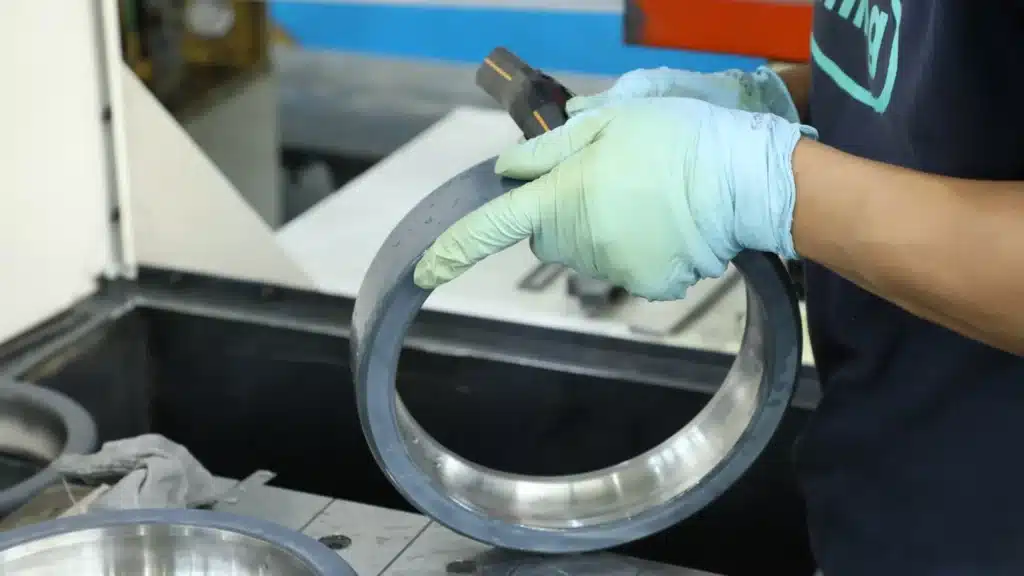

Electrically insulated bearings have become a critical reliability upgrade for industrial motors exposed to variable-frequency drives (VFDs), high bus voltages, and harsh operating environments. By blocking stray shaft currents that would otherwise pass through rolling contacts, they prevent electrical pitting, fluting, noise, and early failure. For plants under pressure to cut downtime and maintenance costs, understanding how insulated bearings work-and where to use them-is now part of core engineering practice.
Why Standard Motor Bearings Fail in Modern Plants
Stray Currents from VFDs and Power Electronics
Most industrial plants have adopted VFDs to save energy and improve process control. However, PWM switching, long cable runs, and asymmetrical fields produce common-mode voltages between the motor shaft and frame. When this shaft voltage exceeds the breakdown strength of the lubricant film, current discharges through the bearings in tiny arcs.
Over time, these events, known as electrical discharge machining (EDM)-create:
- Microscopic pits and frosted raceways.
- Fluting grooves along inner or outer rings.
- Carbonized, conductive grease that accelerates further damage.
The result is increased vibration, rising temperatures, and eventually catastrophic bearing failure.

Hidden Costs of Electrical Bearing Damage
In industrial plants, a single bearing failure can:
- Trip a critical pump or fan, shutting down a production line.
- Damage rotors, stators, and endbells beyond simple bearing replacement.
- Force costly emergency repairs and rush shipments.
Studies and field experience show that a significant share of early bearing failures in VFD-driven motors is electrically induced rather than purely mechanical. Preventing those failures is a direct path to higher motor reliability.
What Electrically Insulated Bearings Are-and How They Work
Construction and Types
Electrically insulated bearings introduce a high-resistance barrier into the current path between shaft and housing. Two main types dominate industrial use:
i. Ceramic-coated bearings
- A thin ceramic layer (typically plasma-sprayed alumina) is applied to the outer or inner ring.
- The coating delivers megohm-level resistance and high breakdown voltage while the steel core retains full mechanical load capacity.

ii. Hybrid bearings
- Steel rings with ceramic rolling elements (usually silicon nitride).
- The ceramic balls are non-conductive, so current cannot flow through the rolling contact.
Both designs block shaft currents from traversing the bearing, eliminating EDM damage at the raceways.
Electrical Performance
Typical performance figures from manufacturers include:
- Insulation resistance of tens to hundreds of megaohms at 500–1000 V DC for coated bearings.
- Voltage with stand ratings up to and above 1000 V DC for standard industrial ranges, with thicker coatings available for higher voltages.
Such ratings comfortably exceed common-mode voltages seen in most plant VFD applications when installed and maintained correctly.
How Insulated Bearings Improve Motor Reliability in Industrial Plants
Eliminate Electrical Pitting and Fluting
By interrupting the electrical path, insulated bearings prevent the formation of pits and fluting altogether:
- The lubricant film remains an insulator rather than a breakdown path.
- Raceways maintain their original surface finish and geometry.
- Grease does not carbonize from repeated arcing.
In reliability terms, this removes an entire failure mechanism, allowing bearings to approach their calculated mechanical life instead of failing prematurely.
Reduce Noise, Vibration, and Heat
Fluted bearings produce a characteristic high-frequency “whine” and elevated vibration that can disrupt processes and violate noise limits, especially in HVAC and clean-room environments. Insulated bearings:
- Keep vibration levels closer to baseline over the motor’s life.
- Prevent localized heating in the bearing caused by electrical hotspots.
- Support more stable operating temperatures, which also protects the lubricant.
This directly improves the perceived quality and smoothness of plant operations.
Extend Mean Time Between Failures (MTBF)
For plants running continuous or batch processes, every increase in bearing life translates to higher MTBF for entire systems. Case histories show that motors retrofitted with insulated bearings often experience multiple times the bearing life of their unprotected predecessors in the same duty.
That improvement:
- Reduces frequency of motor change outs.
- Lowers spare parts consumption.
- Frees maintenance resources for proactive work instead of emergency bearing replacements.
Protect Connected Equipment
Stray currents do not always stop at the motor; they can travel along the shaft into gearboxes, pumps, and process equipment, damaging bearings downstream. Installing insulated bearings in the motor:
- Blocks circulating and shaft currents before they reach driven equipment.
- Reduces bearing failures in critical pumps and gear reducers connected to VFD motors.
This system level protection is particularly valuable in petrochemical, water treatment, and power generation plants where driven equipment is expensive and mission critical.
Where Electrically Insulated Bearings Deliver the Biggest Reliability Gains
VFD-Driven Pumps and Fans
Centrifugal pumps, blowers, and cooling fans are prime candidates:
- They often run continuously at varying speeds via VFDs.
- Bearings see moderate loads but continuous electrical stress.
- Unexpected shutdowns can affect an entire process train.
Using insulated bearings on at least one motor end dramatically reduces unscheduled stoppages due to bearing currents.

Compressors and HVAC Systems
Compressors and large AHUs combine:
- High running hours.
- Strict vibration and noise limits.
- Tall or hard-to-reach motor installations.
Electrically insulated bearings help maintain low vibration and noise levels over long service intervals, improving comfort and process stability.
Large Motors and Generators
Larger frames are more susceptible to circulating currents due to longer shafts and higher magnetic forces. Plants use insulated bearings in:
- Boiler feed and ID/FD fan motors in power plants.
- Generators in CHP and renewable installations.
- High-power compressors and mills.
Here, the cost of a single forced outage justifies premium-bearing insulation easily.
Selecting the Right Insulated Bearing for Plant Motors
Coated vs Hybrid-Which to Choose?
For most industrial motors:
- Ceramic-coated bearings on the outer ring (or inner ring when specified) are the default.
- They are dimensionally interchangeable with standard bearings.
- Cost premium is moderate and widely accepted for VFD duty.
Engineers may choose hybrid bearings when:
- Very high speed or high switching frequency demands lower rolling mass and friction.
- Shaft voltages are especially high or unpredictable (e.g., some EV or high-speed spindle applications).
Where to Place the Insulated Bearing
Typical configurations include:
- One insulated bearing on the non-drive end of the motor for small to medium sizes.
- One insulated bearing plus a shaft grounding ring on the opposite end for larger motors or severe VFD environments.
This arrangement breaks circulating loops while providing a controlled discharge path for stray currents that bypasses the bearings.
Fit, Clearance, and Lubrication Considerations
To get maximum reliability:
- Follow manufacturer guidelines for shaft/housing fits—do not clamp or damage coated surfaces during installation.
- Use recommended internal clearance classes (often C3 or higher for interference fits and larger motors).
- Ensure grease or oil is compatible with both steel and ceramic surfaces and suitable for VFD-related temperature ranges.
Correct mechanical installation prevents secondary failures such as fretting or over-tightened bearings.
Common Electrically Insulated Bearing Model Reference
To assist engineers and procurement teams in identifying the exact replacement parts needed for VFD motors, we have compiled a list of the most frequently requested electrically insulated bearing models.
These complete part numbers typically include the suffix J20AA, J20AB, VL2071 or VL0241, indicating a ceramic coating on the outer ring.
Deep Groove Ball Bearings (Outer Ring Insulated)
Commonly used on both Drive End (DE) and Non-Drive End (NDE) of electric motors.
- 6210-2RS-J20AA-C3 (Sealed, C3 Clearance)
- 6212-M-J20AA-C3 (Brass Cage, C3 Clearance)
- 6214-M-J20AA-C3
- 6314-M-J20AA-C3
- 6316-M-J20AA-C3
- 6318-M-J20AA-C3
- 6322-M-J20AA-C3
- 6324-M-J20AA-C3
- 6326-M-J20AA-C3
- 6330-M-J20AA-C3
Cylindrical Roller Bearings (Outer Ring Insulated)
Commonly used on the Drive End (DE) for high radial loads, belt drives, and larger motors.
- NU 214-E-M1-C3-J20AA
- NU 220-E-M1-C3-J20AA
- NU 316-E-M1-C3-J20AA
- NU 320-E-M1-C3-J20AA
- NU 322-E-M1-C3-J20AA
- NU 328-E-M1-C3-J20AA
- NU 330-E-M1-C3-J20AA
- J20AA / VL0241: Indicates Ceramic Coating on the Outer Ring (most common).
- J20B / VL2071: Indicates Ceramic Coating on the Inner Ring.
- C3: Internal clearance greater than normal (standard for electric motors to account for thermal expansion).
- M / M1: Machined brass cage (preferred for vibration resistance in VFD applications).
Note: TFL Insulated Bearings manufactures precise, drop-in replacements for all the specific model numbers listed above. We can also customize the coating location (inner vs. outer ring) based on your specific motor design requirements.
Implementation Strategy for Industrial Plants
Identify High-Risk Motors
Maintenance and reliability teams should start by listing:
- Motors on VFDs or soft starters.
- Machines with repeated bearing failures or unexplained fluting.
- Large or critical drives where downtime cost is high.
These become candidates for insulated bearing upgrades at the next planned outage.
Standardize Specifications
Plants can formalize insulated bearing usage by:
- Updating motor procurement specs to require insulated bearings for all VFD-driven motors above a certain power or frame size.
- Including shaft grounding provisions and cabling best practices in the same specification.
- Coordinating with OEMs to ensure compatibility with warranties and drive recommendations.
Standardization ensures future motors arrive “VFD-ready” instead of requiring ad-hoc retrofits.
Integrate into Reliability and Maintenance Programs
Insulated bearings fit naturally into reliability frameworks:
- Record presence and type of insulated bearings in motor asset records.
- Trend vibration and temperature to confirm that bearing electrical erosion is no longer occurring.
- Consider periodic insulation-resistance checks between shaft and frame on critical assets as a verification step.
This data helps justify the investment and fine-tune where insulation is most valuable.
Train Maintenance Personnel
Maintenance teams should understand:
- How to recognize electrical fluting and pitting during teardown.
- Correct mounting methods for coated bearings (avoiding blows on coated surfaces).
- How shaft grounding rings and insulated bearings work together.
Training reduces handling damage and ensures upgrades are installed correctly.
Example Benefits Summary Table
| Aspect | Standard Bearings on VFD Motors | Electrically Insulated Bearings on VFD Motors |
| Electrical pitting/fluting risk | High | Very low |
| Typical bearing life | Often months a few years (in severe duty) | Approaches mechanical design life |
| Noise and vibration over time | Increases due to fluting | Stays closer to baseline |
| Unplanned downtime | Frequent bearing related trips | Significantly reduced |
| Impact on driven equipment | Currents may damage pump/gear bearings | Currents are blocked or redirected away from bearings |
| Retrofit complexity | N/A | Usually, drop-in replacement for the same size |
In industrial plants where VFDs, high-efficiency motors, and compact generators are now the norm, electrically insulated bearings are one of the most effective tools for improving motor reliability. By breaking the current path through the rolling contacts, they eliminate electrical pitting and fluting, reduce noise and vibration, and significantly extend bearing and motor life.
When combined with good grounding, appropriate cable practices, and sound mechanical installation, insulated bearings turn stray shaft currents from a mysterious failure source into a controlled design factor. For reliability engineers and maintenance managers tasked with reducing downtime and lifecycle costs, specifying insulated bearings for VFD-driven and critical motors is no longer an option-it is best practice.
Upgrade Your Plant Reliability with TFL Insulated Bearings
At TFL Insulated Bearings, we understand that in a busy industrial plant, unscheduled downtime is the enemy. We know that when a critical VFD motor fails due to electrical fluting, it costs you more than just the price of a bearing—it costs production time and maintenance resources. That is why we are dedicated to manufacturing high-performance ceramic-coated bearings that provide a permanent shield against stray currents.
Don’t wait for the next vibration alarm to trigger a shutdown. Proactively protect your assets with our proven insulation technology.
- Replacing a failed bearing? We have a wide inventory of standard sizes ready to ship.
- Planning a plant-wide upgrade? Our team can help you identify the high-risk motors that need protection first.
Ready to eliminate electrical bearing failures?
- Get a Quick Quote: Click the popup on the sidebar to send us your requirements instantly.
- Email Our Team: info@sdtflbearing.com
- Call Us: +86 15806631151
Switch to TFL Insulated Bearings today and keep your plant running smoothly.