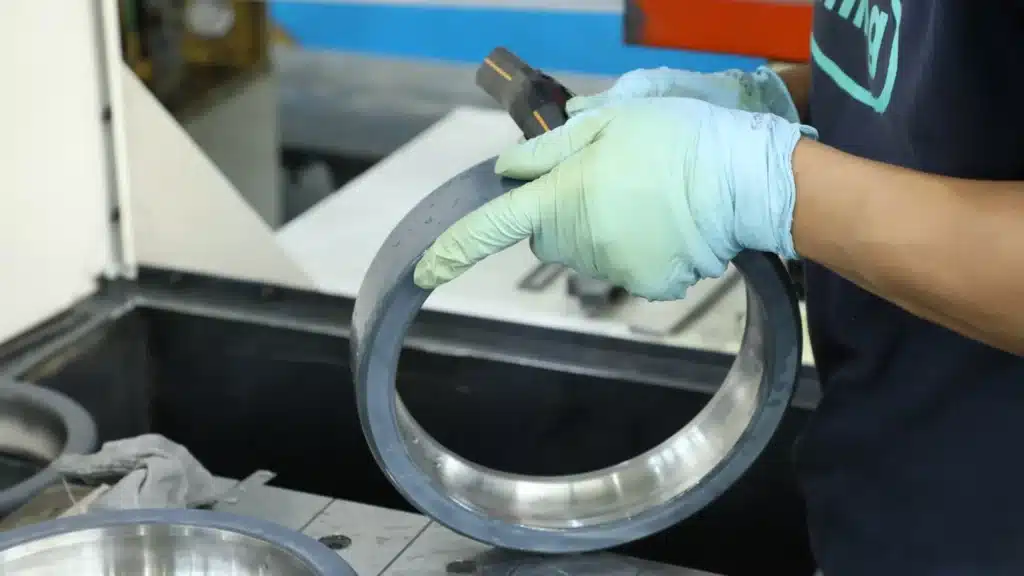

Shaft grounding rings are now common on VFD-driven motors and generators because they offer a simple way to divert harmful shaft currents away from bearings. They use conductive fibers or brushes to short the shaft to the frame, sending common-mode current safely back to the drive. Grounding rings are powerful tools-but they are not a complete solution on their own. Contamination, wear, circulating current paths, and installation limits all mean that grounding rings should be paired with electrically insulated bearings for robust, long-term protection.
This engineering guide explains how shaft grounding rings actually work, where they help, where they fall short, and why combining them with insulated bearings offers the most reliable defense against VFD-induced bearing damage.
Why VFD Motors Need Bearing Protection
Shaft Voltages and Bearing Currents
Variable-frequency drives control speed using high-frequency pulse-width modulation (PWM). The high dv/dt switching and asymmetric output create common-mode voltages between the motor windings and ground. Through capacitive coupling, part of this voltage appears between the rotor/shaft and the frame. If there is no low-impedance path for the current to return to the VFD, it often chooses the path through the bearings.
When shaft voltage exceeds the dielectric strength of the lubricant film, the film breaks down and tiny arcs occur between the rolling elements and raceways. Over time, these events cause electrical pitting and fluting, leading to noisy, high-vibration bearings that fail long before their mechanical life.

Consequences in Industrial Equipment
In industrial fans, pumps, compressors, and conveyors, bearing currents:
- Increase vibration and high-frequency noise.
- Raise bearing temperatures and accelerate lubricant degradation.
- Lead to unexpected bearing seizures and damage to shafts, housings, and even driven equipment.
Reducing those currents is therefore critical for reliability.
How Shaft Grounding Rings Work
Basic Principle
Shaft grounding rings (also called shaft grounding brushes or rings) are designed to provide a low-impedance path from the motor shaft to the frame or ground. The most common designs use:
- A circular aluminum or stainless-steel ring mounted around the shaft.
- Hundreds to thousands of fine conductive microfibers (often silver-graphite) that lightly contact the shaft surface all around its circumference.
The fibers maintain multiple parallel contact points as the shaft rotates. High-frequency common-mode currents prefer this easy path to ground rather than the higher-impedance path through the bearings.

Current Path with Grounding Ring Installed
With a grounding ring at (usually) the drive end:
- PWM switching generates common-mode voltage at the motor terminals.
- Capacitive coupling raises the shaft potential relative to the frame.
- The grounding ring’s fibers conduct that current directly to the frame/earth.
- Bearing voltage is reduced, cutting the number of EDM discharges through raceways.
When installed correctly, grounding rings can significantly lower shaft-to-frame voltage and associated bearing current.
Strengths of Shaft Grounding Rings
Effective for High-Frequency Common-Mode Currents
Grounding rings are particularly good at draining high-frequency capacitive currents caused by VFDs. Because they present very low impedance at these frequencies, much of the common-mode current is bypassed before it ever reaches the bearing.
Simple Retrofit and Visual
They are:
- Relatively easy to retrofit on existing motors.
- Visible and easy to inspect for wear or contamination.
- Compatible with a wide range of frame sizes.
For many smaller VFD motors, the first instinct is to add a grounding ring to control bearing currents.

Why Shaft Grounding Rings Alone Are Not Enough
Despite their benefits, grounding rings have limitations that make them insufficient as the only protection in many installations.
They Depend on Clean, Continuous Contact
Grounding rings only work when their fibers maintain good electrical contact with the shaft. Performance can be degraded by:
- Dust, oil, or paint build-up on the shaft surface.
- Corrosion or scoring where the fibers ride.
- Worn or damaged fibers due to misalignment or harsh environments.
If contact becomes intermittent, instantaneous shaft voltage can rise and discharge across bearings again, even though a ring is present.
They Do Not Block All Types of Bearing Currents
Grounding rings mainly divert common-mode capacitive currents. But VFD systems can also produce:
- Circulating currents in larger motors, where current flows from one bearing to the other through the shaft because of magnetic asymmetry.
- Rotor ground faults or external faults that push current through bearings despite a grounding ring.
Insulated bearings are still needed to break these current loops, especially in medium and large machines.
They Cannot Protect All Connected Equipment
Even with a grounding ring on the motor, part of the current can:
- Travel through couplings and into pump or gearbox shafts.
- Seek bearings in driven equipment that are not equipped with any protection.
Plants have reported cases where grounding rings reduced motor bearing failures but pump or gearbox bearings still suffered fluting, requiring additional insulated bearings at other points in the train.
Installation and Grounding Quality Matter
If the motor frame or pedestal is not well bonded to plant earth, or the ring is mounted incorrectly, grounding effectiveness drops sharply. In some cases, the path from the ring to the VFD return is not low-enough impedance, so significant voltage still appears at the bearings.
Why Combining Shaft Grounding Rings with Insulated Bearings Works Best
Insulated Bearings Break the Last Inadvertent Path
Electrically insulated bearings, whether ceramic-coated or hybrid ceramic, provide megohm-level resistance between shaft and housing. When you use:
- An insulated bearing at one motor end
- A shaft grounding ring at the other end
you both:
- Offer an easy, low-impedance path for common-mode currents (through the grounding ring), and
- Make it difficult for any remaining current to find its way through the bearings (because of the insulation).
This two-layer strategy is far more robust than either measure alone.

Protection for Whole Drive Trains
If you also place insulated bearings in the most critical pump, fan, or gearbox positions, you create multiple barriers:
- Grounding ring at the motor to bleed off the most common-mode current.
- Insulated motor bearings to stop residual or circulating currents.
- Optional insulated bearings in driven equipment where necessary to ensure no stray paths remain.
This approach effectively turns bearing currents into a controlled, predictable design variable, not a random failure cause.
Practical Engineering Guidelines
Where to Use Grounding Rings
Grounding rings are beneficial:
- On the drive end of VFD-driven motors, close to the coupling.
- On motors with long cable runs or high switching frequencies.
- As mandatory protection on large motors feeding critical loads.
They should be installed according to the manufacturer’s instructions, with:
- Clean, machined shaft surface under the fibers.
- Proper mechanical centering and secure mounting.
- Reliable bonding from the ring housing to the motor frame and earth.
Where to Add Insulated Bearings
Insulated bearings are strongly recommended when:
- Motors operate with VFDs, and repeated bearing failures or fluting patterns have been observed.
- Frame size and shaft length make circulating currents probable.
- Motors drive critical pumps, compressors, or fans where downtime is very costly.
Typical configuration:
- Insulated bearing on the non-drive end of the motor.
- Grounding ring on the drive end.
In larger machines or special applications, both motor bearings may be insulated, and grounding rings may be placed strategically per OEM guidance.
Table: Grounding Ring vs Insulated Bearing vs Combination
| Feature / Aspect | Shaft Grounding Ring Only | Insulated Bearings Only | Combination (Ring + Insulated Bearing) |
| Diverts high-frequency CM currents | Yes, if clean and well-grounded | Not directly | Yes |
| Blocks circulating / rotor currents | Partially, not guaranteed | Yes (breaks current path) | Yes |
| Relies on shaft contact | Yes (fibers/brush) | No (built-in insulation) | Only for the bypass path |
| Protects driven equipment | Limited | Better (if used in equipment bearings) | Best when applied to motor and equipment |
| Sensitivity to contamination | High | Low | Moderate |
| Best use case | Small motors, low-cost enhancement | Motors where currents are known risk | Critical VFD-driven systems and large motors |
Implementation Steps for Reliability Engineers
- Audit VFD-Driven Motors
- Identify motors on VFDs, especially with long cables or high switching frequencies.
- Review failure history for signs of electrical erosion (fluting, pitting, blackened grease).
- Prioritize Critical Assets
- Focus on pumps, fans, and compressors whose downtime is expensive or safety-critical.
- Rank motors by power rating and duty cycle; large and continuously running machines are prime candidates.
- Specify Combined Protection
- For each priority motor, specify an insulated bearing and shaft grounding ring rather than one or the other.
- For new purchases, require VFD-ready motors with these features built in.
- Train Maintenance Staff
- Show examples of fluting and pitting so technicians can recognize electrical erosion.
- Train teams to clean shafts properly before installing rings and to handle insulated bearings without damaging coatings.
- Monitor Results
- Trend vibration, temperature, and failure rates after upgrades.
- Use insulation-resistance tests or shaft-voltage checks on critical machines when practical.
Secure Your VFD Operations with TFL Insulated Bearings
As we have explored in this guide, relying solely on shaft grounding rings can leave your critical assets vulnerable to circulating currents and contamination failures. To achieve true peace of mind, you need the robust, final line of defense that only high-quality insulation can provide.
At TFL Insulated Bearings, we specialize in manufacturing precision bearings with advanced ceramic coatings designed specifically to withstand the harsh electrical environments of modern VFD systems. We don’t just sell bearings; we provide the missing half of your protection strategy.
Ready to stop electrical erosion for good?
- Contact Us Today: Send your requirements to info@sdtflbearing.com.
- Call Our Experts: Reach us directly at +86 15806631151 for immediate technical support.
- Get a Fast Quote: Click the inquiry button on the sidebar to tell us about your motor specifications.
Don’t let stray currents shorten your equipment’s life. Partner with TFL for reliable, long-term bearing protection.