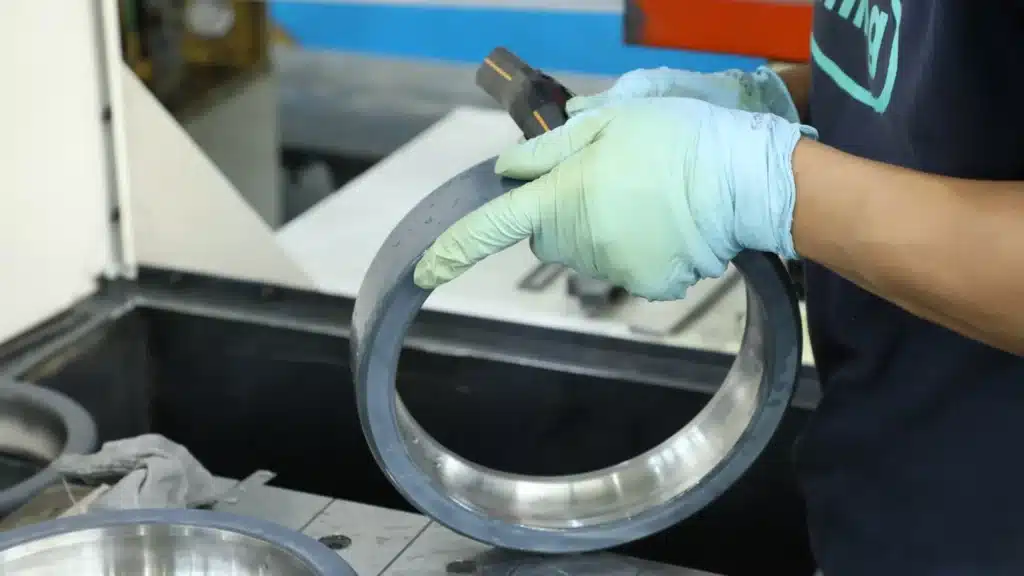

Variable-frequency drives (VFDs) have become standard on centrifugal pumps and compressors to save energy, improve process control, and reduce mechanical stress. But they also introduce a hidden reliability problem: shaft currents that pass through the motor and driven-equipment bearings, causing electrical pitting, fluting, and premature failures. Electrically insulated bearings, especially ceramic-coated and hybrid designs, are now one of the most effective ways to stop these VFD-induced failures in rotating equipment trains.
Why VFDs Cause Bearing Problems in Pumps and Compressors
Shaft Currents and Common-Mode Voltage
VFDs control motor speed using high-frequency pulse-width modulation (PWM). The fast-switching edges create common-mode voltages between the inverter output and ground, which couple into the motor rotor and shaft. When there is no low-impedance path to return this current to the drive, the shaft voltage discharges through:
- Motor bearings
- Couplings and shafts
- Pump or compressor bearings
Each discharge event is a tiny electrical arc that erodes metal surfaces.
Electrical Erosion: Pitting and Fluting
Once shaft currents travel through bearings, they produce characteristic damage:
- Electrical pitting: microscopic craters and frosted raceway surfaces created by localized melting.
- Fluting: washboard-like grooves on inner or outer rings formed when repeated discharges coincide with mechanical vibration.
- Carbonized grease: dark, burnt lubricant that loses its insulating properties.
In pump and compressor trains, this damage can first appear in motor bearings, but it can also occur in the first bearing set downstream, typically the pump drive-end bearing or the gearbox input bearing.

Consequences for Pump and Compressor Reliability
Increased Vibration, Noise, and Heat
As electrical erosion progresses:
- Vibration amplitudes at bearing defect frequencies rise.
- Operators hear high-frequency whine or growl, especially at certain speeds.
- Bearing temperatures climb, even when the hydraulic or gas load is unchanged.
These symptoms often trigger vibration alarms or process trips long before the bearing completely fails.
Unplanned Downtime and Secondary Damage
When a bearing finally fails due to VFD-induced erosion, it can:
- Seize and twist shafts or couplings.
- Contaminate lubricants with debris, damaging other bearings.
- Force emergency shutdowns of critical pumps or compressors, halting production.
In many plants, these failures recur on the same VFD-driven trains until the root electrical cause is addressed.
How Electrically Insulated Bearings Stop VFD-Induced Damage
Creating a High-Resistance Barrier
Electrically insulated bearings introduce a high-resistance layer into the bearing structure, preventing current from using the rolling contacts as a return path. Common industrial solutions include:
- Ceramic-coated bearings: a plasma-sprayed aluminum-oxide coating on the inner or (more often) outer ring, providing megohm-level insulation and high breakdown voltage.
- Hybrid bearings: steel rings with ceramic balls (usually silicon nitride), so the rolling elements themselves are non-conductive.
In both cases, stray shaft currents are blocked at the bearing, forcing them to flow through designed paths such as shaft grounding rings or cable shields.

Drop-In Replacement with Standard Dimensions
Insulated bearings are manufactured to ISO dimensions:
- Same bore, outer diameter, and width as standard bearings.
- Same or very similar load ratings and speed limits.
That means most pumps and compressors can be upgraded simply by selecting insulated versions of their existing bearing sizes, without redesigning housings or shafts.

Where to Use Insulated Bearings in Pump and Compressor Trains
Motor Bearings
The motor driving a pump or compressor is usually the main source of PWM-induced shaft currents. Installing insulated bearings in the motor:
- Prevents currents from crossing the motor’s rolling contacts.
- Reduces the chance that currents propagate through couplings into pump or compressor bearings.
Common configurations:
- Small/medium motors: one insulated bearing on the non-drive end (NDE).
- Larger motors: insulated bearing on one end plus a shaft-grounding device on the other to provide a safe discharge path.
Pump and Compressor Bearings
In some applications, it is also wise to use insulated bearings in the driven equipment:
- Where shaft conductivity and couplings still allow some current to bypass insulated motor bearings.
- Where process shutdowns are extremely costly, and added protection is justified.
- In vertical pumps or multi-stage compressors, where bearing arrangements are particularly sensitive.
Adding insulation to the pump or compressor bearings creates multiple barriers to current flow, sharply reducing the risk of erosion throughout the train.
Recommended Insulated Bearing Models for Common Pump Motors
To help you select the right protection for your VFD-driven equipment, here are some of the most frequently used insulated bearing sizes for industrial pump and compressor motors:
- 6316 C3 VL0241 (Common for medium-sized pump motors, NDE position. Brass cage options)
- 6314 C3 VL0241 (Standard size for HVAC and process pump motors)
- 6314 C3 VL2071 (Inner ring insulated, often used where housing fit is tight)
- NU 322 ECM C3 VL0241 (Cylindrical roller bearing for heavy-load compressor applications)
- 6218 C3 VL0241 (Versatile size for various auxiliary pumps)
Need a specific size or a hybrid ceramic option? View our full catalog on the product page or contact us for cross-reference assistance.
Practical Engineering Benefits in Pumps & Compressors
Longer Bearing Life and MTBF
By eliminating EDM damage, insulated bearings let bearings fail (if at all) due to conventional mechanical mechanisms-fatigue, contamination, or poor lubrication-rather than electrical erosion. Plants report:
- Bearing life in VFD-driven pumps and compressors improves from months to many years after retrofitting insulated bearings.
- Significant reductions in repeat failures on the same trains.
This directly increases the mean time between failures (MTBF) and reduces lifecycle costs.
More Stable Vibration and Process Control
With bearings protected from fluting:
- Vibration spectra remain closer to baseline over time.
- Critical process pumps and compressors stay within vibration limits longer, reducing nuisance trips.
- Operators see fewer unexplained spikes in condition-monitoring data.
Stable vibration translates to more predictable process performance and easier balancing and alignment work.
Lower Total Cost of Ownership
Although insulated bearings cost more than standard bearings, they often pay back quickly through:
- Fewer emergency repairs and call-outs.
- Reduced production losses from unplanned outages.
- Extended motor and pump overhaul intervals.
For mission-critical pumps and compressors, the economics are particularly favourable.
Selecting Insulated Bearings for Pump & Compressor Applications
Coated vs Hybrid – Which Is Better?
For most general-purpose pump and compressor drives:
- Ceramic-coated bearings offer the best balance of cost, robustness, and availability.
- They handle typical speeds and loads and are easy drop-in replacements.
Hybrid bearings may be preferred when:
- Rotational speeds are very high.
- VFD switching frequencies or voltages are extreme.
- There is a desire for lower friction and reduced operating temperatures.

Choosing Bearing Locations
Typical strategies in industrial pump/compressor trains:
- Motor only: Insulated NDE motor bearing plus grounded drive-end bearing.
- Motor and pump: Insulated bearings in the motor and at least one bearing in the pump for high-risk services (e.g., boiler feed pumps, high-pressure compressors).
- Gearbox applications: Insulated bearings on gearbox input shafts when the motor is also insulated but currents may still couple into the gearbox structure.
Each train should be evaluated for shaft grounding path, criticality, and historical failure data.
Fit, Clearance, and Lubrication
Insulated bearings should be installed following manufacturer’s recommendations:
- Use correct shaft and housing fits-not too tight on coated surfaces.
- Choose internal clearance classes appropriate for interference fits and temperature (often C3 for larger drives).
- Use lubricants compatible with ceramic surfaces and consider grease types suited to VFD-related temperature cycles.
Proper installation ensures you gain electrical benefits without introducing mechanical problems.
Implementation Roadmap for Reliability Teams
Step 1: Identify Problem Trains
Start with:
- Pump and compressor trains driven by VFD motors.
- Systems with a history of frequent bearing failures or characteristic fluting damage.
- High-criticality assets where unscheduled downtime is expensive.
Review vibration and failure reports to confirm electrical erosion indicators (fluting, burnt grease, raceway pitting).
Step 2: Define an Insulated Bearing Strategy
For each train, decide:
- Which bearings will be insulated (motor DE/NDE, pump DE/ODE).
- Whether shaft grounding rings should be added to ensure a defined current path.
- What insulation ratings (voltage, resistance) are needed based on the drive and motor configuration.
Coordinate choices with motor, pump, and VFD suppliers where possible.
Step 3: Update Specifications and Spares
- Update plant standards and project specifications so new VFD-driven pumps and compressors arrive with insulated bearings as standard.
- Ensure spare-parts lists differentiate between insulated and non-insulated bearings, to avoid accidental downgrades during repairs.
Step 4: Monitor Results
After implementation:
- Track changes in failure rates, vibration trends, and unplanned outages.
- Document improvements in MTBF and maintenance cost.
- Use this data to refine where insulated bearings are most beneficial and justify broader rollout.
Application Table
| Application | Typical Issue | Insulated Bearing Solution |
| Cooling water pumps on VFDs | Repeated DE motor bearing fluting | Insulated NDE motor bearing + shaft grounding ring |
| Boiler feed pumps | Motor and pump DE bearing pitting | Insulated bearings in motor and pump DE |
| HVAC supply fans | Noise and vibration from fluted bearings | Insulated motor bearings, improved cabling |
| Process gas compressors | High downtime cost due to bearing failure | Hybrid or coated bearings in the motor and compressor |
Protect Your Critical Assets with TFL Insulated Bearings
At TFL Insulated Bearings, we understand that unplanned downtime in pump and compressor trains is not an option. We have engineered our coatings and hybrid solutions specifically to handle the harsh electrical environments created by modern VFDs. By upgrading to TFL’s electrically insulated solutions, we help you eliminate the root cause of electrical erosion, ensuring your rotating equipment runs smoother, longer, and more efficiently.
Don’t wait for the next bearing failure to halt your production.
Contact us today to discuss your specific application or to request a quote for your fleet.
- Call Us: +86 15806631151
- Email Us: info@sdtflbearing.com