
Quick Definition: Shaft voltage is the cumulative electrical potential generated between a motor’s rotating shaft and its grounded frame. In VFD-driven systems, it is primarily caused by pulse-width modulation (PWM) switching, leading to electrostatic discharge (ESD) through bearings that creates fluting, pitting, and premature failure.
What Is Shaft Voltage and Why Does It Matter?
Shaft voltage is the difference in electric potential between the rotating shaft (or rotor) and the grounded frame of the machine. It exists whenever the rotor is capacitively or inductively coupled to energized windings, external fields, or static charges.
If a safe, low-impedance path to ground is not provided, this voltage keeps building until it finds its own path-often through the thin lubricant film in the bearings. When the film breaks down, current flows through microscopic contact points, acting like tiny EDM discharges. Over time, this produces:
- Frosted raceways and pits
- Fluting grooves
- Carbonized grease, noise, heat, and early bearing failure
Surveys and industry data attribute a significant share of motor failures in inverter-fed systems to shaft-voltage-driven bearing currents.
Main Causes of Shaft Voltage
VFD PWM Switching and Common-Mode Voltage
Modern variable-frequency drives use pulse-width modulation (PWM) with fast IGBT switching. While efficient, this technology creates a parasitic effect known as Common Mode Voltage (click to read our deep-dive guide). These steep voltage edges couple capacitively from the stator windings to the rotor, seeking the path of least resistance to ground—often through your bearings.
- Create common-mode voltage between the three phases and ground
- Couple capacitively from stator windings to rotor and shaft
- Drive high-frequency currents that seek a return path through bearings, couplings, or grounding hardware
High DC bus voltages, high switching frequencies, and long motor cables all increase the induced shaft voltage and associated bearing current.

Stray Capacitance Inside the Motor
Every motor has stray capacitances between:
- Stator windings and stator core
- Stator and rotor across the air gap
- Rotor/shaft and frame through bearings and lubricant
Together, these form a capacitive network. At mains frequency, their impedance is high; at kHz PWM frequencies, it becomes low, so voltage and current couple readily onto the shaft. Motor size, winding layout, insulation system, and frame grounding all affect the magnitude of this coupling.
Magnetic Imbalance and Inductive Coupling
Non-symmetrical magnetic fields in large machines can induce a voltage directly in the rotor body:
- Eccentric air gaps
- Unequal phase loading
- Saturation in part of the core
This inductively induced shaft voltage is more prominent in high-power motors and generators. It often contributes to “circulating currents” that run from one bearing, along the shaft, and back through the other bearing.
External Sources and Static Charging
Other contributors include:
- DC machines with brush leakage to the shaft
- Belt-driven equipment where rubber belts generate static
- Nearby high-voltage equipment inducing fields into the shaft or coupling
These effects are usually secondary compared to VFD-related causes but can be significant in special applications.
Risks: From Shaft Voltage to Bearing and System Damage
Uncontrolled shaft voltage leads to several risks:
Bearing EDM damage
- Pits and fluting reduce bearing life from years to months
- Increased vibration and noise require unscheduled shutdowns

Damage to driven equipment
- Shaft voltage can propagate through couplings into pump or gearbox bearings
- Sensitive mechanical seals or gear teeth may also be affected
Insulation stress and safety issues
- High shaft-to-frame voltage stresses insulation in couplings, encoders and feedback devices
- In extreme cases, operators may feel small shocks touching ungrounded rotating parts
Costly downtime
- Replacing bearings alone may not solve the root cause
- Repeated failures drive up maintenance costs and reduce confidence in the equipment
⚡ Stop Shaft Voltage Damage Today
Identifying shaft voltage is only the first step. Permanently blocking the current path with TFL Insulated Bearings is the ultimate solution to prevent costly downtime.
Need a technical consultation?
How to Measure Shaft Voltage
Instruments and Setup
To verify the problem, the most common method is to measure shaft voltage directly while the motor runs:
- Use an oscilloscope or high-speed data logger with sufficient bandwidth
- Connect via a shaft-voltage probe or small graphite / conductive brush contacting a clean spot on the shaft
- Reference the other side of the measurement to the motor frame or plant ground
For safety, measurements are typically done with enclosed probe fixtures or slip rings designed for the task.
What to Look For
Key points in the waveform:
- Peak shaft voltage: frequent peaks above tens of volts (for many applications, >30-40 V is a concern)
- Discharge patterns: sharp, repetitive spikes where the waveform suddenly collapses indicate breakdown events through bearings
- Correlation with drive switching: bursts synchronized with PWM carrier frequency confirm VFD-driven origin
Complementary checks, such as inspecting failed bearings for fluting or frosting and trending vibration, help confirm that the measured shaft voltage is translating into real damage.

Solutions: Reducing Shaft Voltage and Protecting Bearings
Effective solutions manage shaft voltage by changing either the source, the path, or the victim (bearings).
Improve Grounding and Bonding
- Ensure the motor frame is solidly bonded to the drive enclosure and plant earth with low-impedance connections
- Eliminate paint and corrosion at ground lugs; use dedicated grounding conductors rather than relying on conduit alone
- Bond driven equipment and bases so any induced voltage returns to the same reference instead of across bearings
Good grounding does not eliminate shaft voltage, but it reduces floating potentials and encourages currents to return via hardware rather than through lubricant films.
Use Shaft Grounding Rings or Brushes
Shaft grounding rings surround the shaft with conductive micro-fibres or brushes that lightly contact the rotating surface:
- Provide a deliberate low-impedance path from shaft to frame
- Drain high-frequency currents before they arc through bearings
- They are especially important on the drive end of VFD motors
They require clean mounting surfaces and periodic inspection to maintain good contact and avoid contamination.
Install Electrically Insulated Bearings
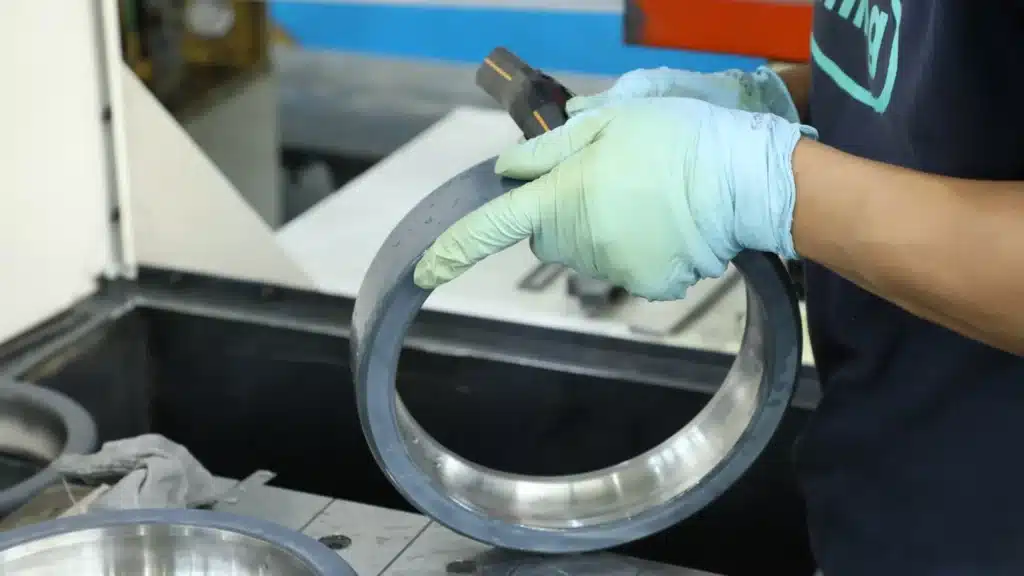
Electrically insulated bearings-either with a ceramic-coated ring or ceramic rolling elements—break the electrical circuit at the bearing:
- Coated-ring designs add a plasma-sprayed ceramic barrier between the ring and housing or shaft
- Hybrid bearings use ceramic balls, so current cannot pass through the rolling contact
Common strategies:
- Insulated bearing on the non-drive end plus a shaft grounding ring on the drive end
- For larger motors or generators, insulated bearings at one or both ends, supplemented by grounding devices
Insulated bearings protect the bearing itself, but they do not remove shaft voltage-hence the need to coordinate with grounding and filtering.
Common Insulated Bearing Models for VFD Motors
To effectively block shaft voltage, selecting the right insulated bearing is crucial. Here are some of the most standard sizes used in VFD-driven industrial motors (VL0241 denotes an electrically insulated outer ring):
- 6314 M/C3 VL0241 (Standard deep groove ball bearing for mid-sized motors)
- 6316 M/C3 VL0241 (Common NDE bearing for 75kW+ motors)
- 6322 M/C3 VL0241 (Heavy-duty insulated bearing for large pumps/fans)
- NU 322 ECM/C3 VL0241 (Cylindrical roller bearing for high radial loads)
- 6218 M/C3 VL0241 (Versatile size for general industrial applications)
If you are unsure which bearing suits your motor shaft voltage requirements, please contact our engineering team for a cross-reference.
Optimize VFD and Cable Configuration
Because most shaft-voltage problems originate at the drive:
- Use shorter motor leads where possible; long cables add capacitance and common-mode current
- Select shielded or symmetrical cables recommended by the drive manufacturer
- Apply dv/dt filters or common-mode chokes at the VFD output for long runs or critical machines
- Adjust switching frequency when permitted—lower frequencies generally reduce high-frequency content, though this must be balanced against audible noise and drive performance
These steps raise the effective impedance of the path from drive to ground at damaging frequencies and reduce the magnitude of induced shaft voltage.
Motor Design and OEM Measures
Motor OEMs can reduce inherent shaft voltage by:
- Symmetrical magnetic design and tight tolerances to minimize inductive imbalance
- Optimized winding layout and insulation to control stray capacitance
- Built-in insulated bearings and shaft-grounding provisions for “VFD-ready” motor series
Specifying these features during procurement avoids later retrofits.
Practical Selection Guide: Which Measures to Use When?
| Situation | Recommended Measures |
| Small VFD motor, short cable | Good grounding; shaft grounding ring often sufficient |
| Medium motor, long cable | Grounding + shaft ring + one insulated bearing + output filter |
| Large motor (>100 HP) on critical load | Grounding + shaft ring + insulated bearing(s) + cable/drive optimization |
| Generator in wind / industrial plant | Insulated bearings in generator ends + grounding + monitoring |
| Motor directly coupled to sensitive pump | Motor grounding + insulated motor bearing + consider insulated pump bearing |
This combined approach balances cost and reliability across different motor sizes and criticalities.
Monitoring and Maintenance
Once mitigation is in place, ongoing checks help confirm long-term effectiveness:
- Periodic shaft-voltage spot checks on critical machines
- Vibration trending to watch for new fluting-like signatures
- Bearing inspections during overhauls, looking for electrical damage patterns
- Verification that grounding straps, shaft rings, and filters are clean, intact, and properly connected
When shaft voltage is controlled, new bearings should show normal mechanical wear rather than EDM features, and motor reliability improves noticeably.
Stop Shaft Voltage From Destroying Your Equipment
Shaft voltage is an invisible enemy, but the damage it causes to your bearings is very real. At TFL Insulated Bearings, we specialize in cutting the circuit that leads to failure. Our ceramic-coated and hybrid bearing solutions are designed to withstand the high-frequency currents generated by modern VFDs, ensuring your motors run reliably without the risk of electrical erosion.
Frequently Asked Questions
What is an acceptable level of shaft voltage?
While tolerance varies by bearing type and lubricant, most NEMA and IEC guidelines suggest that shaft voltage peaks should remain below 10 to 20 Volts (peak-to-ground). Levels exceeding 30V are highly likely to cause EDM pitting and fluting damage over time.
Can grounding alone fix shaft voltage?
Not entirely. Proper frame grounding is essential for safety, but it does not remove the voltage potential on the rotor. To protect bearings, you typically need a combination of shaft grounding rings (to drain charge) and insulated bearings (to block the path).
Don’t let a stray arc shut down your production line. Let us help you select the perfect insulation strategy for your specific application.
Contact us today for a technical consultation or a quick quote.
- Email Us: info@sdtflbearing.com
- Call Us: +86 15806631151