
Quick Answer: Common mode voltage in VFD systems is a parasitic voltage generated by the fast switching of PWM inverters. It acts as the primary source of VFD induced bearing currents and leakage currents, which discharge through motor bearings, causing electrical fluting, pitting, and premature failure unless mitigated by insulated bearings or grounding rings.
Common mode voltage is one of the most important-and most overlooked-electrical side effects of Variable Frequency Drives (VFDs). It is the root cause of damaging shaft voltages, bearing currents, and premature electrical erosion in modern motors. When common-mode voltage is not controlled, bearing pits and flutes, and insulation are overstressed, and motors that should last years can fail in months.
This guide explains what common-mode voltage is, how it affects motor bearings, and what insulation and grounding strategies OEMs and end users should apply in VFD systems.
What Is Common-Mode Voltage in VFD Systems?
In a three-phase VFD, each output phase is rapidly switched between the DC bus rails using PWM (pulse-width modulation). At any instant, the three-phase voltages rarely sum exactly to zero because the switches are at different states and the DC midpoint is floating. The average of the three output-phase voltages relative to ground is called the common-mode voltage.
This common-mode component acts as a high-frequency voltage source that drives displacement currents through the parasitic capacitances of the cable, stator windings, rotor, and bearings. The higher the DC bus voltage, switching frequency, and dv/dt, the larger and faster the common-mode voltage swings become.

How VFD Induced Bearing Currents & Leakage Occur
The VFD-cable-motor combination forms a capacitive network that allows high-frequency signals to bypass standard grounds. This phenomenon creates bearing leakage current—a specific type of stray current that travels from the stator, jumps across the bearing’s oil film, and grounds through the shaft. This breakdown is driven by:
- Cable conductors to ground
- Stator windings to stator core
- Stator to rotor across the air gap
- Rotor/shaft to frame through bearings and lubricant
Common-mode voltage couples through these capacitances and raises the rotor/shaft potential relative to the stator and frame. When shaft-to-frame voltage exceeds the breakdown field strength of the lubricant film in the bearing (often tens of volts in VFD systems), the film punctures locally, and a discharge occurs. This is seen as:
- Capacitive EDM currents-brief, intense pulses through the bearing contact.
- Circulating currents-loops where current enters one bearing, flows along the shaft, and exits through the other.
🚫 Stop Replacing Motors Due to Fluting
Don’t let Common Mode Voltage destroy your VFD-driven equipment. TFL Insulated Bearings provide the most reliable barrier against shaft currents, meeting IEC 60034-25 standards.
Ready to secure your assets?
Impacts on Motor Bearings and Insulation
Electrical Erosion and Bearing Life
Bearing currents driven by common-mode voltage remove metal from raceways, forming microscopic craters. When synchronized with mechanical vibration or cage frequencies, they form regular fluted grooves, dramatically increasing vibration and noise. Plants report that VFD-driven motors without protection may see bearing life cut from years to less than a year in severe cases.

Stress on Winding and Cable Insulation
Common-mode voltage also stresses:
- Motor stator insulation, particularly at the end turns.
- Cable insulation, where reflected wave phenomena can create overvoltage’s.
International standards such as IEC TS 60034-25 and NEMA MG1 Part 31 explicitly address these risks. They categorize the insulation requirements for “inverter duty” motors to withstand the high dv/dt voltage spikes. Specifically, IEC 60034-25 recommends disrupting the common mode current path using insulated bearings at the non-drive end (NDE) for motors frame size 280 and above.
Why VFD Systems Generate High Common-Mode Voltage
Several design factors magnify standard-mode voltage in real installations:
- Fast switching devices (IGBTs, SiC): High dv/dt edges excite parasitic capacitances more strongly.
- Long motor cables: Longer cables have greater capacitance to ground, lowering the impedance of the common-mode path.
- Ungrounded or poorly grounded systems: High impedances in return paths allow higher shaft voltages to develop.
- High DC bus voltage: Higher supply voltage scales common-mode voltage amplitude.
Without mitigation, these factors combine to create substantial shaft voltage and damaging bearing currents.
Measuring Common-Mode and Shaft Voltage
Common-Mode Voltage
Engineers typically calculate or simulate common-mode voltage from the PWM pattern, but it can also be measured directly using:
- Three differential probes on the motor terminals
- A math function on the oscilloscope to average the three phase voltages with respect to ground
Waveforms reveal the characteristic high-frequency steps that drive common-mode currents.
Shaft Voltage and Bearing Current
On operating motors, a conductive brush or ring lightly contacting the shaft is connected to an oscilloscope referenced to the frame. Repeated peaks in shaft voltage and sharp collapses indicate discharge events through bearings.
Clamp meters or shunts on grounding straps can give additional insight into common-mode current magnitude returning via engineered paths instead of bearings.

Insulation Requirements in the Presence of Common-Mode Voltage
Because common-mode voltage cannot be fully eliminated, motors, cables, and bearings used with VFDs need enhanced insulation:
- Stator windings: “Inverter-duty” designs with higher turn-to-turn and phase-to-ground insulation levels, partial discharge resistance, and corona-resistant wire.
- Cables: VFD-rated shielded cables with proper 360-degree shield terminations to provide a low-impedance common-mode return path and protect nearby equipment.
- Bearings: Electrically insulated bearings to interrupt common-mode current loops through the rotor.
NEMA MG1-2018 Part 31 and various OEM engineering guides explicitly recommend insulating both bearings on induction motors to interrupt common-mode voltage effects, especially in higher-power machines or where cable lengths are long.
Electrically Insulated Bearings and Common-Mode Voltage
Electrically insulated bearings are one of the most effective ways to block bearing currents induced by common-mode voltage.
Types of Insulated Bearings
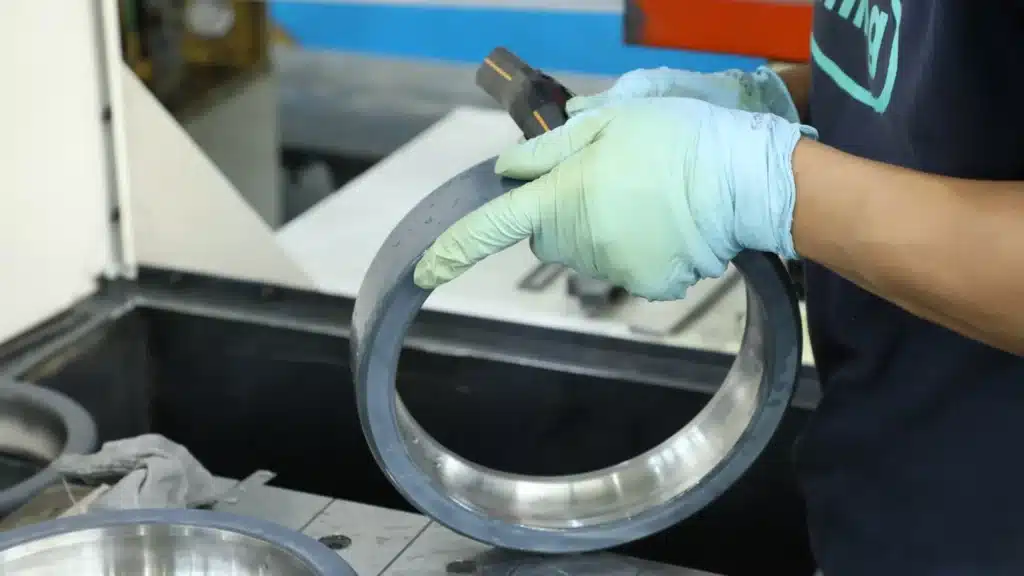
- Ceramic-coated bearings: A plasma-sprayed aluminum-oxide or polyimide coating applied to the outer or inner ring provides megohm-level insulation and high breakdown voltage.
- Hybrid ceramic bearings: Steel rings with ceramic balls; current cannot flow through the rolling elements and is forced to bypass the bearing.
Where to Use Them
Best practices from OEMs and industry guides include:
- Insulating both bearings for high-power or hazardous-duty VFD motors to block circulating currents.
- Insulating at least the non-drive-end bearing and using a shaft grounding device on the drive end for general-purpose VFD motors.
- Considering insulated bearings in driven equipment (pumps, gearboxes) when shaft potential can transfer across couplings.
Benefits
Field data and case studies show:
- Substantial reduction in electrical pitting and fluting.
- Lower vibration and noise levels over the motor lifetime.
- Fewer unexpected bearing failures and lower maintenance costs.
Recommended Insulated Bearing Models for VFD Mitigation
To effectively block common mode voltage as described in this section, selecting the right bearing specification is crucial. Below are common configurations often used to replace standard bearings in VFD motors (referencing standard industry dimensions with insulation suffixes):
- 6316 M/C3VL0241 (Deep Groove Ball Bearing, electrically insulated outer ring)
- NU 322 ECM/C3VL0241 (Cylindrical Roller Bearing, insulated for heavy radial loads)
- 6330 M/C3VL2071 (Large bore insulated bearing, inner ring insulation)
- 6210-2RS1/C3VL0241 (Sealed insulated bearing for smaller VFD motors)
These models represent standard sizes widely used to interrupt damaging current loops.
Other Mitigation Methods for Common-Mode Voltage
Electrically insulated bearings are essential but work best alongside other measures that address the common-mode problem at its source.
Shaft Grounding Rings
Shaft grounding rings or brushes provide a low-impedance path from shaft to frame, discharging common-mode voltage before it crosses bearings.
- Typically installed on the drive-end shaft extension.
- Often combined with an insulated bearing at the opposite end for maximum protection.
- Require clean contact surfaces and inspection over time.
Common-Mode Chokes and Filters
Common-mode chokes are magnetic cores placed around all three motor leads; they increase impedance to common-mode current without affecting differential-mode torque-producing current.
- Can reduce harmful common-mode current by up to roughly 65% in many systems.
- Do not eliminate shaft voltage entirely, but noticeably reduce stress on bearings and insulation.
More advanced dv/dt or sine-wave filters smooth PWM edges, reducing both overvoltage and common-mode components, at the expense of extra cost and losses.
Proper Grounding and Cabling
Industry guides stress that cabling and grounding layout are critical:
- Use VFD-rated shielded cables with continuous, low-impedance shields.
- Terminate shields with 360-degree clamps at both drive and motor end.
- Bond motor frames, cable trays, and panels with wide, low-inductance straps.
- Avoid pigtail ground connections that add high-frequency impedance.
These steps define a preferred path for common mode current back to the inverter, so less of it tries to return through bearings.
Table: Quick Comparison of Mitigation Options
| Solution | Main Role | Strengths | Limitations |
| Insulated bearings | Block current through bearings | Directly stops EDM/fluting; long-term fix | Cost: must be installed correctly |
| Shaft grounding rings | Provide low-Z shaft-to-the frame path | Simple, effective; ideal with insulated NDE | Wear/contamination; needs maintenance |
| Common-mode chokes/filters | Reduce common-mode voltage/current | Benefit whole system; no moving parts | Extra space, cost; not a complete solution |
| Shielded VFD cables | Define CM return path | Lower EMI; better control of shaft voltages | Must be installed and terminated correctly |
| Improved grounding | Lower impedance for CM currents | Low-cost baseline; benefits all equipment | Alone, rarely enough for severe VFD duty |
Insulation Requirements Summary for VFD-Driven Motors
For reliable operation in the presence of common-mode voltage, a VFD system should meet these insulation-related requirements:
- Motor windings: Inverter-duty insulation system per IEC TS 60034-25 or NEMA MG1 Part 31, with adequate partial-discharge resistance.
- Bearings: At least one, and often both, bearings are insulated in motors above a certain frame size or in critical service; hybrid bearings are considered for high-frequency or high-speed drives.
- Cabling: VFD-rated shielded cable with proper high-frequency terminations and routing to minimize stray capacitance to unintended structures.
- System design: Inclusion of common-mode chokes or dv/dt filters where cable runs are long, plus engineered grounding paths that steer common-mode currents away from bearings.
Protect Your VFD Systems with TFL Insulated Bearings
Common mode voltage is an invisible threat, but the damage it causes to your machinery is very real. Don’t wait for your motors to fail prematurely. At TFL Insulated Bearings, we specialize in high-performance ceramic-coated bearings designed specifically to block these harmful currents and extend the lifespan of your VFD-driven equipment.
Whether you need a drop-in replacement or a custom solution for a high-voltage project, we are here to help you secure your investment.
Take action today to prevent downtime:
- Email us for a quote: info@sdtflbearing.com
- Call our engineering team: +86 15806631151
- Browse our catalog: Click the sidebar to view our full range of insulated solutions.
Frequently Asked Questions
What causes common mode voltage in VFDs?
Common mode voltage is caused by the Pulse Width Modulation (PWM) switching frequency of the VFD. Because the three output phases do not sum to zero effectively at any given instant, it creates a floating neutral voltage that seeks a path to ground through the motor bearings.
How do I stop VFD bearing currents?
The most effective methods include using electrically insulated bearings (ceramic coated or hybrid) to block the current path, installing shaft grounding rings to divert the current to the frame, and ensuring the use of VFD-rated shielded cables with proper grounding.
Does IEC 60034-25 require insulated bearings?
Yes, IEC TS 60034-25 recommends utilizing insulated bearings to prevent circulating currents. This is particularly recommended on the non-drive end (NDE) for larger motors (typically frame size 280 and above) driven by converters.